
Annuities Explained: Types, Rates and When to Use Them
An annuity can fit money dedicated to predictable accumulation or contractual retirement income. Choose fixed interest for rate certainty, fixed-indexed crediting for limited index-linked growth, and an income rider or annuitization when lifetime payments matter. Keep near-term reserves separate, and compare accessible cash rather than treating an income benefit base as savings.
Annuity proposals combine accumulation, income timing, guarantees and tax rules. Separate these choices to compare contracts on equal terms rather than choosing the largest advertised percentage.
Key Considerations
- A fixed rate, an index credit and a lifetime-income payout factor measure different things.
- Cash surrender value determines cash-out access; an income benefit base does not.
- An IRA annuity needs an insurance-based reason, not a claim of additional tax deferral.
Choose the Accumulation Method Before Comparing Rates
Choose fixed interest for rate certainty or fixed-indexed crediting for limited index-linked growth. Market-exposed annuities involve different risks.
A fixed annuity credits insurer-set interest; compare its rate, guarantee period, minimum and renewal terms. A fixed-indexed annuity (FIA) uses an index-linked formula, not index ownership. Caps, participation rates or spreads limit credits. A nonnegative crediting floor does not prevent withdrawals or rider fees from reducing value.
RILAs permit index-related losses under contractual limits; variable annuities expose value to selected investments. Investor.gov explains these categories and risks.
Immediate versus deferred describes income timing, not risk or tax registration. Deferred does not mean principal-protected. Guarantees depend on the issuing insurer's contract and claims-paying ability.
Read Account Value, Surrender Value and Benefit Base Separately
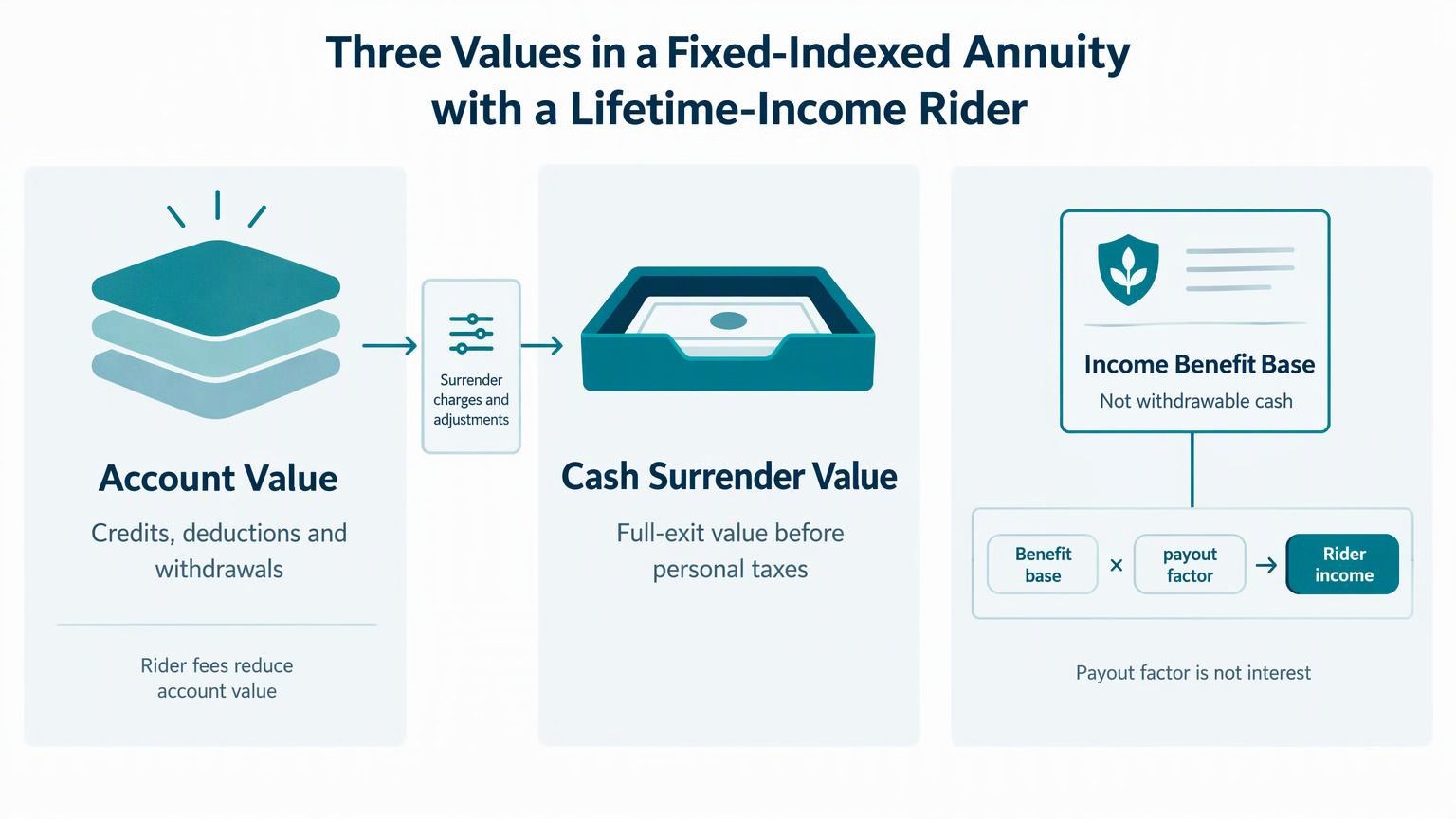
Read these values separately: accumulation, cash-out access and rider income use different calculations.
- Account value: Accumulated value after credits, deductions and withdrawals.
- Cash surrender value: Full-exit proceeds after surrender charges and contractual adjustments, before personal taxes.
- Income benefit base: A calculation value for rider income and sometimes fees, not withdrawable cash.
Nassau explains the noncash benefit base; features vary by product. Increasing it can improve income without increasing cash-out value.
Surrender charges have a specified contractual period. After that period ends, you can generally take remaining value without the expired surrender charge, providing greater cash-access flexibility. Contract adjustments, withdrawal provisions, rider effects and tax rules can still affect the amount you receive and any continuing benefits.
| Income Route | Suitable When | Trade-Off and Remaining Access |
|---|---|---|
| Systematic withdrawals | You want withdrawals without electing a lifetime-income guarantee. | Access follows contract terms; withdrawals alone do not guarantee income for life. |
| Lifetime-income rider | You want lifetime withdrawals and access to any remaining value under rider rules. | Fees and excess withdrawals can affect values or benefits; the benefit base is not cash. |
| Annuitization | You prioritize the selected contractual payment stream. | Additional access and survivor payments depend on the payout election and contract. |
Compare a Lifetime-Income Rider With Annuitization
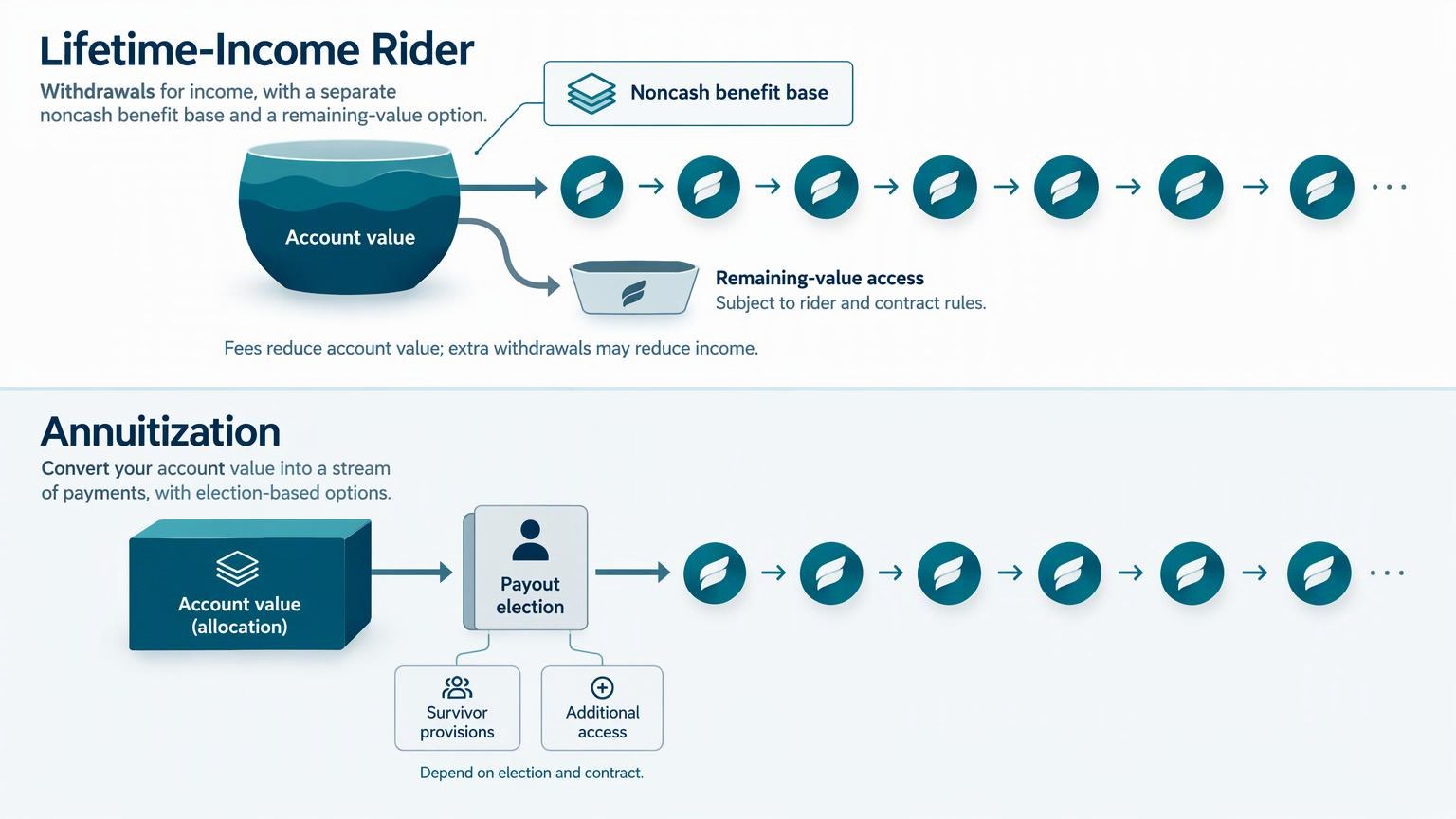
Choose a lifetime-income rider when lifetime withdrawals and access to remaining value matter. Consider annuitization when converting an allocation into a selected payment stream is your priority.
An FIA rider typically calculates income using a benefit base and payout factor, not an interest return. Payments may continue after account value is depleted if rider conditions remain satisfied. Rider fees reduce account value.
Annuitization establishes payments under your payout election rather than rider withdrawals; remaining access and survivor provisions depend on that election and contract.
If the actual rider permits pausing and resuming withdrawals, that flexibility may help you adjust income when spending needs or other income sources change. Confirm restart terms, fees and effects on future benefits in the proposed rider; a pause does not necessarily leave benefits unchanged.
Extra rider withdrawals may reduce guaranteed income, and lump-sum access follows contract and rider rules. Payments and deductions change account value, so subtracting income from an untouched growth projection does not establish remaining cash.
Identify the Income Feature You Actually Need
Discuss with Rene whether your priority is lifetime withdrawals, a selected payout stream or accumulation without an income rider.
Separate Tax Registration From the Insurance Contract
Evaluate insurance features separately from tax registration: the same annuity category can serve different tax arrangements.
An annuity in a traditional IRA or tax-deferred employer plan adds no tax deferral; its reason must be contractual interest or income protection. An IRA differs from an employer-qualified plan.
Eligible rollover amounts can fund an IRA annuity separately from new annual contributions. Rollovers generally do not use the regular annual IRA contribution limit, but must satisfy applicable rollover rules. New IRA contributions remain subject to eligibility requirements and annual limits; buying an annuity does not expand them.
A nonqualified annuity generally uses after-tax money outside retirement plans and offers tax-deferred accumulation, not tax-free income. Distribution treatment depends on basis, earnings and payment form.
For a Roth IRA, qualified distributions require the five-year period beginning with the first tax year for which you contributed to a Roth IRA for your benefit, plus a qualifying event, such as reaching 59½. Regular contribution returns are excluded from gross income; nonqualified earnings may be taxable. Conversions have separate rules. IRS Publication 590-B explains Roth IRA distributions.
IRAs do not permit owner loans. Some employer plans permit participant loans under plan and tax rules. An IRA annuity withdrawal is not a loan.
Apply the Choice to an Uncertain Cash Need
Keep reserves for unresolved obligations outside your income allocation.
Hypothetical situation: A California business owner approaching retirement wants lifetime income but faces a business obligation of unknown final cost. Preserving that reserve is the constraint.
Annuitizing all savings could compromise access. An FIA rider on all savings would not solve this: extra withdrawals could reduce future income.
Keep the reserve separate, then compare the remaining long-term allocation. A rider may suit remaining-value access; annuitization may suit payment-stream certainty. If no suitable allocation remains, postponement is reasonable. Make this choice within your broader retirement planning and protection goals.
Work With Rene Farias on a Focused Contract Comparison
Rene Farias is an independent insurance advisor working with California clients and multiple carriers. Based in Los Angeles, he offers Zoom strategy sessions to compare insurance-based retirement options.
Start with your spending gap, income date and required reserves. Compare proposals using the same allocation, start date and survivor objective:
- Guaranteed and nonguaranteed crediting.
- Account and surrender values at relevant dates.
- Rider calculations, fees and excess-withdrawal effects.
- Surrender schedule, adjustments and remaining access.
- Tax registration and beneficiary provisions.
The life insurance and retirement planning FAQs address related questions. Tax advisers handle distribution treatment; appropriately authorized securities professionals handle securities transactions. Rene's insurance role does not establish those separate authorities.
Work With Rene Farias
Rene Farias works with California families, professionals and business owners to compare insurance-based protection and retirement-planning strategies. He is based in Los Angeles and offers strategy sessions over Zoom.
Frequently Asked Questions
Should I Replace an Existing Annuity for a Higher Advertised Rate?
Only if replacement improves the overall arrangement after exit consequences. Compare guarantees, renewal terms, fees and income provisions, not just the advertised rate. Leaving may trigger surrender charges and forfeit benefits; the new contract may start another surrender period, limiting access again.
What Happens to Income When a Covered Person Dies?
The income election controls. Single-life rider payments generally stop when the covered person dies; survivor continuation requires the relevant option. Beneficiary benefits are separate from lifetime income. Review both provisions rather than assuming unused premium or the benefit base automatically passes to heirs.
Can Early Access Create Both an Insurer Charge and a Tax Consequence?
Yes. Surrender charges arise from the contract; income taxes and applicable early-distribution taxes arise from tax law. Neither replaces the other. Distinguish the insurer's cash-out calculation from after-tax proceeds, and have a tax adviser evaluate your proposed distribution before withdrawing money.
Can I Change My Mind After Receiving the Contract?
State law provides a free-look review period. Your contract should specify its duration and return procedure. Read delivered documents promptly, comparing the rider, surrender schedule and income election with the proposal. Return terms vary, so use your contract's instructions rather than assuming uniform rules.
Are Annuity Guarantees the Same as Bank Deposit Insurance?
No. Guarantees are the issuing insurer's contractual obligations, backed by its claims-paying ability. They can provide meaningful retirement protection, but not FDIC deposit insurance or an unlimited government guarantee. Evaluate the promised benefit and insurer rather than treating all guarantees as equivalent.
Define Your Income Allocation Before Comparing Proposals
Bring your spending gap, income start date and cash-reserve needs to a strategy session with Rene Farias to narrow the accumulation method and income option for your long-term allocation.