
Business Succession Planning in California: Step-by-Step Guide
Start business succession planning by defining your exit goals and assigning responsibility, then choose who will manage and who will own the business. Establish a valuation process, document transfer terms, and match funding to specific obligations. Use insurance for suitable covered risks, not as a substitute for the entire succession plan.
For California business owners, a useful plan must address both a planned departure and an unexpected absence. Your preferred successor may be ready to lead but unable to buy; your preferred buyer may have money but need different management. Work through the steps below before committing to a transfer structure.
Key Considerations
- Test management readiness and purchase capacity separately before choosing a successor.
- Update valuation, purchase terms and funding together rather than revising only the price.
- Rehearse an unexpected absence to expose authority and operating gaps.
Step One: Assign Leadership and Specialist Responsibilities
You should lead the planning decisions as the owner, with an assigned coordinator tracking actions and deadlines. Begin by recording your intended exit timing, income needs, desired future involvement and priorities for family, employees and control.
Give each participant a distinct job:
- Owner and co-owners: Agree on objectives and approve the transition route.
- Potential successor: Demonstrate management readiness and state whether ownership is wanted.
- Attorney: Design and coordinate transfer agreements, governing documents and estate-planning documents.
- Accountant or tax adviser: Evaluate transaction taxes, financial records and payment affordability.
- Valuation specialist: Assess business value using the relevant purpose and assumptions.
- Insurance professional: Compare coverage for identified risks and funding needs.
Rene Farias provides independent insurance-based guidance for California clients. His planning for business owners includes succession-related protection. Legal drafting, tax advice and any retirement-plan administration belong with the appropriate specialists.
Step Two: Choose Who Will Manage and Who Will Own
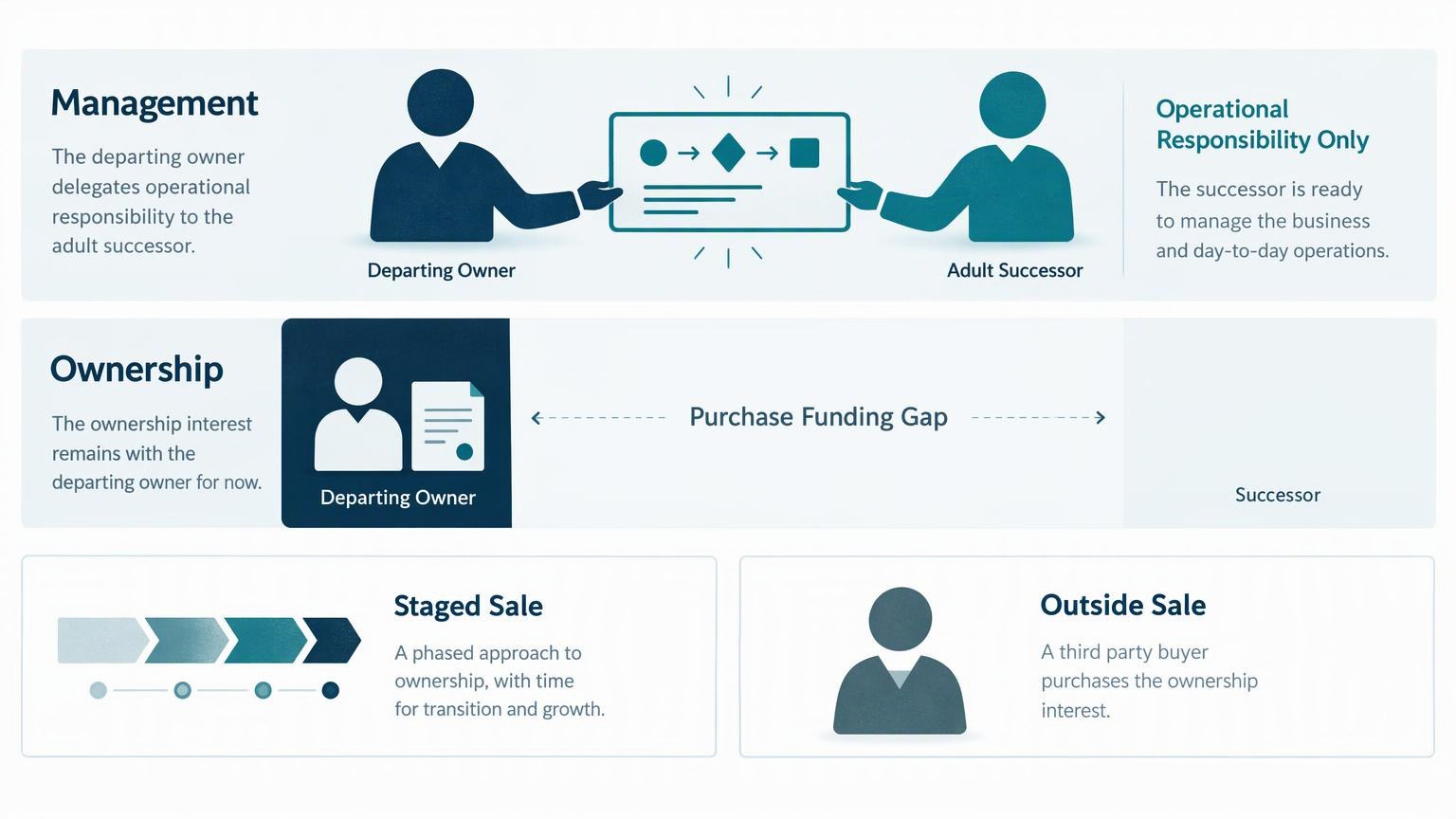
Management succession determines who runs the business. Ownership transfer determines who holds its economic interests and ownership rights. Those roles can pass to different people on different schedules.
Build a candidate list from willing family members, co-owners, employees and potential outside buyers. Evaluate management candidates through delegated decisions and operating responsibilities. Evaluate buyers through willingness to purchase, financing capacity and compatibility with your exit goals.
Favor an internal transition when continuity matters and a credible successor exists. Consider an outside sale when internal candidates lack interest or purchase capacity. Retaining ownership while delegating management can provide preparation time, but it leaves your capital tied to the business. The comparison below separates these routes.
Hypothetical Example: A Ready Manager Without Purchase Cash
Suppose you want to stop daily management but need sale proceeds for retirement. Your adult child can run operations but cannot fund an immediate purchase. A leadership handoff alone meets your workload goal, not your income requirement.
Compare a staged sale, with payment risk assessed by your accountant and attorney, against an outside buyer with credible financing. If you cannot tolerate delayed payments, an outside sale may fit better. If other retirement resources cover the delay, a staged family transfer may remain feasible. Life insurance payable at death does not solve the immediate retirement purchase gap.
| Route | Suitable When | Main Trade-Off |
|---|---|---|
| Family transfer | A willing, capable family successor supports your goals | Readiness and purchase funding may develop at different speeds |
| Co-owner or employee purchase | Internal buyers want ownership and can support payment terms | Your exit depends on their financing and payment capacity |
| Outside sale | You need a buyer beyond the internal candidate pool | Buyer requirements may change leadership and culture |
| Delegate management, retain ownership | You want less daily involvement before transferring equity | Capital remains exposed to business performance |
Step Three: Keep Valuation and Transfer Documents Aligned
Keep valuation current through a defined update process, then make the buy-sell terms use that process consistently. An old agreed price can diverge from the business being transferred.
A fixed price is straightforward but requires active updates. A formula can adapt to financial changes but may miss unusual assets or shifts in earnings quality. An independent appraisal adds cost and time but can address facts a simple formula overlooks. Have the valuation specialist and attorney specify the valuation date, standard, assumptions and dispute procedure.
The agreement should identify the buyer, seller, triggering events, purchase obligation, payment schedule and shortfall treatment. Have counsel reconcile it with entity documents and estate documents, including any relevant California ownership or spousal issues.
Insurance ownership also affects the analysis. In Connelly v. United States, the Supreme Court held that the corporation's fair-market-value redemption obligation did not offset its insurance proceeds when valuing the deceased owner's shares for federal estate tax. Ask your attorney and tax adviser to evaluate an entity-redemption structure before assuming its funding leaves estate value unchanged.
Step Four: Match Funding to the Actual Cash Obligation
Insurance can help fund a death-triggered ownership purchase or provide operating liquidity after a key person's death. It does not automatically finance retirement, voluntary departure or every disability event.
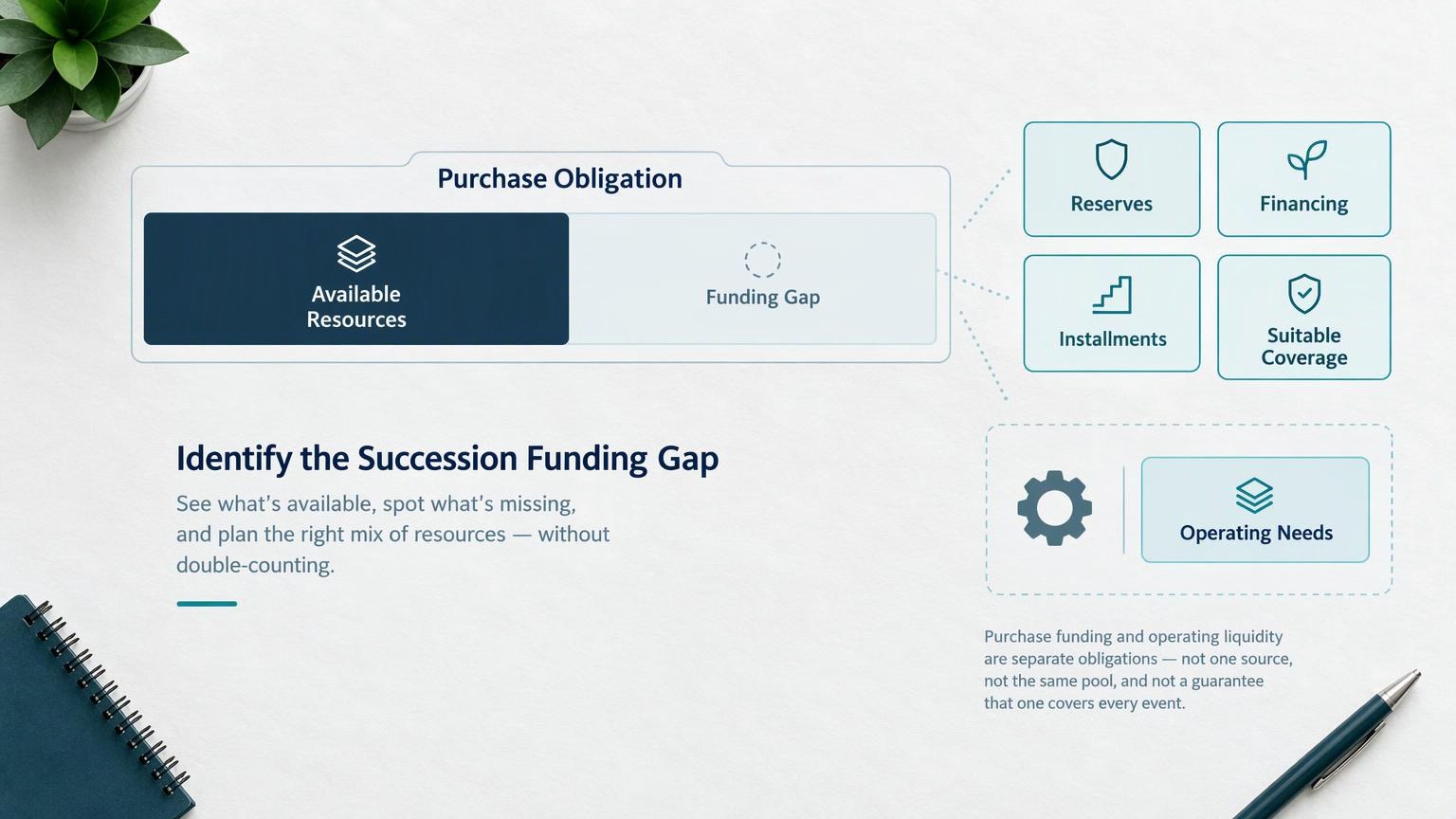
Start with the payment required under each scenario. Subtract resources actually available to the obligated payer without exhausting operating cash. That remaining gap is the funding problem to address through reserves, financing, negotiated installments or suitable coverage.
Buy-sell funding supports an ownership transaction; key-person coverage supports the business's operating loss. Do not count the same proceeds as fully available for both. Policy owner, beneficiary and purchase obligation must align. A personal policy payable to family is not automatically cash available to the business.
Rene can compare insurance options across multiple carriers within the agreed structure. Coverage duration, premium affordability and underwriting matter; approval and outcomes are not guaranteed. His California life insurance guide provides broader coverage context.
For employer-owned coverage, IRS Notice 2009-48 explains notice-and-consent requirements, qualifying exceptions to income exclusion limits and Form 8925 reporting. Have your tax adviser address these requirements before implementation. Income-tax exclusion and estate-tax valuation are separate questions.
Identify the Risk Your Funding Must Cover
Discuss your proposed purchase obligation with Rene Farias over Zoom to compare insurance options for the specific liquidity gap.
Step Five: Review Changes and Test the Handoff
Review the plan when people, business economics, documents or funding change. Set a recurring review date as well, so a dormant agreement does not become the default plan.
Use this compact event checklist:
- A successor leaves, declines ownership or becomes unavailable.
- An owner dies, becomes disabled, divorces or changes retirement timing.
- Ownership, debt, earnings or major assets change materially.
- A policy changes, lapses or no longer matches the obligation.
- A legal or tax development affects the chosen structure.
Then test an unexpected owner absence. Identify who can authorize payments, supervise employees and communicate with customers. Confirm lawful access to essential records and systems, without relying on shared personal passwords.
Record unresolved actions, responsible people and completion dates. Keep the operating handoff alongside the ownership plan: a funded purchase does not itself tell employees who is in charge tomorrow.
Work With Rene Farias
Rene Farias works with California families, professionals and business owners to compare insurance-based protection and retirement-planning strategies. He is based in Los Angeles and offers strategy sessions over Zoom.
Frequently Asked Questions
Can I Start Before I Have a Successor?
Yes. Define your exit goals, document essential responsibilities and improve financial records while you evaluate candidates. An interim management arrangement can address an absence without committing to a permanent buyer. Avoid naming someone solely because they are available or related to you; willingness and readiness still matter.
Is a Will Enough for Business Succession?
No. A will does not by itself establish operational readiness, purchase financing or a coordinated business transfer. Ask your attorney to align estate intentions with entity documents and any buy-sell agreement. The practical question is whether the intended recipient can receive, control and manage the interest as planned.
How Should I Handle Children Who Do Not Work in the Business?
Separate your fairness goals from operating authority. Equal ownership is not automatically the best way to support children with different interests. Discuss alternatives involving business interests and other assets with your estate attorney and tax adviser, and make decision rights explicit rather than leaving siblings to negotiate after your departure.
What If the Purchase Price Exceeds Available Funding?
The agreement needs a workable shortfall mechanism, not an assumption that insurance will cover everything. Possible approaches include additional cash, financing or negotiated installments. Have your advisers assess affordability and seller risk. Increasing coverage may be considered, but underwriting and premium requirements can prevent it from being a practical solution.
Should I Tell Employees About the Plan?
Share the operational information employees need, while protecting confidential valuation and transaction details. Clarify reporting lines, interim authority and who will communicate during a transition. Coordinate announcements with your attorney and leadership candidates so employees do not mistake an exploratory ownership discussion for a completed sale or immediate management change.
Decide Whether Your Succession Funding Fits the Plan
Once you have a proposed buyer, valuation method and payment obligation, review the insurance portion with Rene Farias. Use a Zoom strategy session to discuss coverage fit and affordability while your attorney and tax adviser handle the transaction's legal and tax design.