
Do You Pay Taxes on Life Insurance? California Tax Guide
Generally, you do not pay federal income tax on life-insurance proceeds received because the insured person died. Interest, policy surrender gains and some cash-value distributions can be taxable. Loans require additional care, especially with modified endowment contracts or lapse. Estate inclusion is separate, and California filing treatment needs its own review.
Identify whether you are receiving a beneficiary payment, accessing an existing policy or changing ownership. That classification determines which rules matter. This guide explains federal treatment for California readers; use your tax adviser to resolve state reporting and your specific circumstances before a transaction.
Key Considerations
- Separate death-benefit principal from taxable interest in the insurer’s payment statement.
- Compare withdrawal, surrender and borrowing using policy basis, MEC status and continuing coverage needs.
- Review ownership separately from beneficiary designation when assessing estate exposure.
Are Death Benefits Generally Federal Income-Tax Free?
Yes. Life-insurance proceeds received as a beneficiary because the insured person died are generally excluded from federal gross income. The IRS explains that you generally do not report those proceeds as income, but interest and certain transferred policies require different treatment.
This rule concerns the reason for the payment, not simply the policy’s label. Receiving a death benefit is different from taking cash out while the insured person is alive. Do not apply the beneficiary exclusion to a surrender or withdrawal.
For a family choosing protection, the tax rule is only part of the decision. Match the coverage to the financial obligation and how long it lasts, rather than buying permanent insurance solely because of a tax slogan. Rene’s California life-insurance guidance provides context for comparing protection options.
The federal exclusion also does not settle whether proceeds enter the insured person’s taxable estate.
What Changes With Interest or a Policy Transfer?
Interest paid on life-insurance proceeds is taxable even when the underlying death benefit is excluded. A transfer for cash or other valuable consideration can also limit the death-benefit exclusion, subject to exceptions.
If the insurer retains proceeds and pays interest, separate the protected principal from the earnings. A lump sum may suit a beneficiary who needs immediate control; leaving proceeds with the insurer may suit someone who prefers delayed access. Compare payment terms and interest reporting, not an assumption that everything paid by the insurer has the same tax treatment.
For a compensated policy transfer, the IRS describes an exclusion generally limited to the consideration paid, additional premiums and certain other amounts. Exceptions mean that neither “every transfer is taxable” nor “changing owners never matters” is reliable.
Business owners should obtain tax and legal review before moving coverage between owners or entities. Business succession insurance may support a continuity plan, but the policy’s tax treatment and the buy-sell documents require separate analysis.
| Transaction | General Federal Treatment | Planning Consequence |
|---|---|---|
| Death benefit | Generally excluded from beneficiary income | Separate any interest and review ownership exceptions. |
| Interest on proceeds | Taxable interest | Keep the principal and earnings breakdown. |
| Full surrender | Gain above adjusted basis is taxable | Weigh tax cost against ending coverage. |
| Non-MEC withdrawal | Generally basis first, with exceptions | Assess reduced values and remaining protection. |
| Non-MEC loan | Generally no current income while in force | Manage debt and lapse-related gain risk. |
| MEC loan or withdrawal | Generally gain first; additional tax may apply | Review taxable amounts before accessing cash. |
When Do Surrender and Withdrawals Create Taxable Gain?
Surrender can create federal taxable income when proceeds exceed your investment in the contract, commonly called tax basis. Certain non-MEC withdrawals generally recover basis first, but exceptions and prior transactions matter.
IRS Publication 525 explains that surrender proceeds above policy cost are included in income. Cost is not always every premium ever paid: refunds, rebates, dividends and unrepaid loans not previously included in income can affect the calculation. Ask the insurer for the transaction’s basis and taxable-gain calculation, rather than relying on the displayed cash value alone.
Hypothetical: Accessing Cash While Keeping Protection
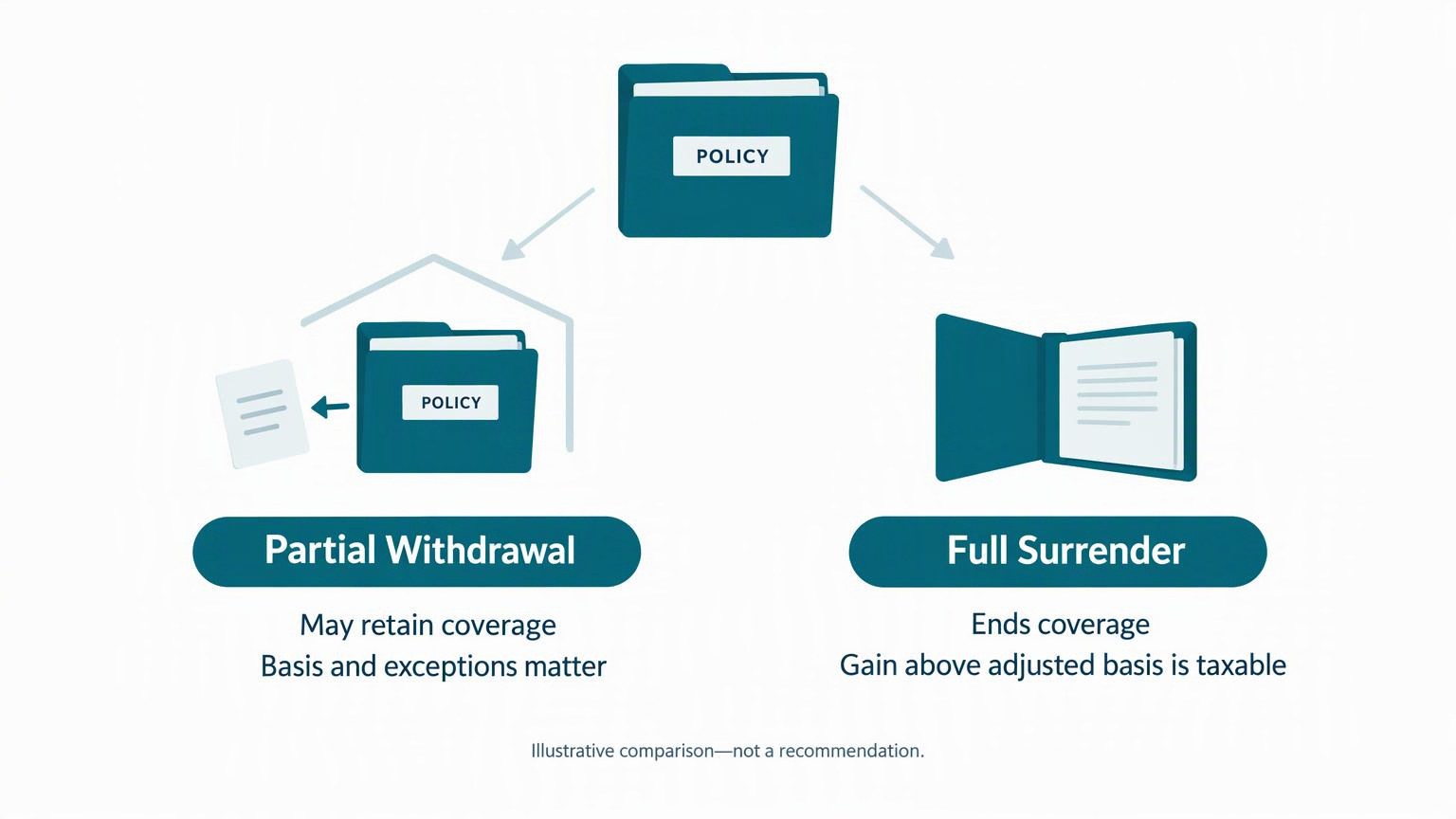
Suppose you need cash but must keep family coverage. Your non-MEC policy has gain, and the proposed withdrawal is below confirmed remaining basis. Assume no special withdrawal exception applies. A partial withdrawal may meet the cash need without current federal taxable income, although it reduces policy values and may reduce the death benefit. Full surrender would terminate coverage and recognize gain above adjusted basis. Under those constraints, the withdrawal is the better starting option, provided the remaining policy is sustainable. If coverage is no longer needed, surrender may instead fit despite its tax cost.
Compare Cash Access With Your Coverage Needs
Discuss with Rene whether retaining, borrowing against or surrendering coverage fits your protection and retirement goals, alongside your tax adviser’s analysis.
How Do MEC Status and Lapse Affect Policy Loans?
A loan from a non-MEC life-insurance policy is generally not current federal taxable income while the policy remains in force. A modified endowment contract, or MEC, changes that result: loans are treated as distributions, with gain generally coming out before basis.
Internal Revenue Code Section 72 establishes the MEC distribution rules. Its taxable portion may also incur a 10% additional federal tax before age 59½ unless an exception applies, such as qualifying disability or qualifying substantially equal periodic payments.
Even a non-MEC loan is not a promise of permanently tax-free income. Loan interest and policy charges affect sustainability. If the policy lapses or is surrendered with outstanding debt, extinguishing that debt can produce taxable gain even when little or no cash reaches you.
Borrowing may suit someone who wants to retain coverage and can manage the debt. It is a poor fit when the funding plan depends on ignoring loan costs. Review an updated in-force illustration under less favorable assumptions before borrowing.
Why Is Estate Inclusion Different From Income Tax?
Income tax asks whether a recipient has taxable income. Estate-tax inclusion asks whether proceeds count in the deceased person’s gross estate. A payment can be excluded from the beneficiary’s income while still entering the estate calculation.
Internal Revenue Code Section 2042 includes proceeds payable to the executor and proceeds payable to other beneficiaries when the deceased retained incidents of ownership at death. Naming a family member as beneficiary therefore does not, by itself, resolve estate inclusion. Inclusion does not automatically mean tax is due; the overall estate calculation matters.
Put the Review in the Right Order
First identify the transaction, then collect the records that determine its treatment:
- Insurer payment or proposed transaction statement.
- Policy basis, MEC status and outstanding loan balance.
- Current owner, beneficiary designation and transfer history.
- Relevant tax forms and an updated illustration for continuing coverage.
Use your tax adviser for federal and California reporting, and an estate attorney for ownership or trust changes. Rene Farias, an independent insurance advisor based in Los Angeles, helps California clients compare insurance-based protection and retirement strategies over Zoom. That insurance discussion complements, rather than replaces, tax and legal advice.

Work With Rene Farias
Rene Farias works with California families, professionals and business owners to compare insurance-based protection and retirement-planning strategies. He is based in Los Angeles and offers strategy sessions over Zoom.
Frequently Asked Questions
Are Life-Insurance Premiums Tax-Deductible for Business Owners?
Usually no. Do not assume a premium becomes deductible simply because a business pays it or the coverage supports business continuity. Compensation arrangements and employer-owned coverage raise separate questions. Have your tax adviser evaluate the actual arrangement before treating a payment as a deduction on your return.
Does Receiving a Form 1099 Mean the Entire Payment Is Taxable?
No. A tax form can distinguish gross proceeds from a taxable portion. Publication 525 says a surrender Form 1099-R should show total proceeds and the taxable part. Compare the form with the insurer’s statement and your transaction records; ask for clarification or correction if the amounts do not reconcile.
Does Calling a Strategy a TFRA Change Its Tax Rules?
No. TFRA is a marketing term for a permanent-life-insurance strategy, not a separate IRS-qualified retirement account. The underlying policy and transaction determine treatment. Review the TFRA strategy disclosures when evaluating cash access, charges and lapse risk, rather than assuming the name guarantees tax-free retirement income.
Are Accelerated Death Benefits Always Excluded From Income?
No blanket exclusion applies to every living-benefit payment. Publication 525 explains that certain accelerated death benefits for terminally or chronically ill insured people can be excluded. Eligibility and payment conditions matter. Have your tax adviser review the specific benefit and claim circumstances rather than applying the ordinary beneficiary rule automatically.
Can I Use This Guide Alone to File My California Return?
No. This guide explains federal distinctions, not a complete California filing determination. Give your tax adviser the insurer’s statements, tax forms and transaction history so state treatment can be evaluated separately. This is particularly important when basis adjustments, business ownership or prior policy transactions complicate the federal calculation.
Decide What Your Policy Should Do Next
Use a strategy session with Rene Farias to discuss your next insurance decision: maintaining family protection, accessing cash value or supporting business continuity. Bring the policy questions that emerged here, and coordinate any transaction with your tax adviser or estate attorney before implementation.