
Fixed Annuity Rates in 2026: How California Retirees Can Compare Options
When comparing fixed annuity rates in 2026, favor a multiyear guarantee if you want predictable crediting and can leave the money committed. Consider a shorter guarantee only with a clear understanding of renewal uncertainty. The best fixed annuity rates for you must also fit withdrawal needs, surrender terms and insurer backing.
A rate advertisement is a starting point, not a complete retirement proposal. California retirees need to know what happens both while the contract is held and when money comes out. This guide explains how to compare offers without treating a promotional rate as a long-term promise.
Key Considerations
- Compare guaranteed crediting over the same holding period, not just the opening rate.
- Evaluate early-access proceeds after both surrender charges and any market value adjustment.
- Decide whether you need accumulation or income before requesting comparable quotes.
What Does a Fixed-Annuity Rate Actually Guarantee?
A fixed-annuity rate guarantees interest only to the extent and for the period stated in the contract. Separate the current credited rate from the minimum guaranteed rate and the date each promise ends.
The California Department of Insurance's senior annuity guide explains that fixed-annuity interest is set by the insurer under contract terms and warns against assuming a high advertised rate will last. A minimum guarantee is not necessarily the rate used in the sales example.
Also distinguish accumulated contract value from cash available on surrender. Guaranteed interest does not erase early-exit charges. Nor does a fixed nominal rate guarantee purchasing power.
The issuing insurer's claims-paying ability supports its contractual guarantees. Assess the actual issuing company, not just a familiar brand name. Financial-strength information should identify its rating agency and date; a rating is an assessment, not a promise that the insurer cannot fail.
Should You Choose a Multiyear Guarantee or a Promotional Rate?
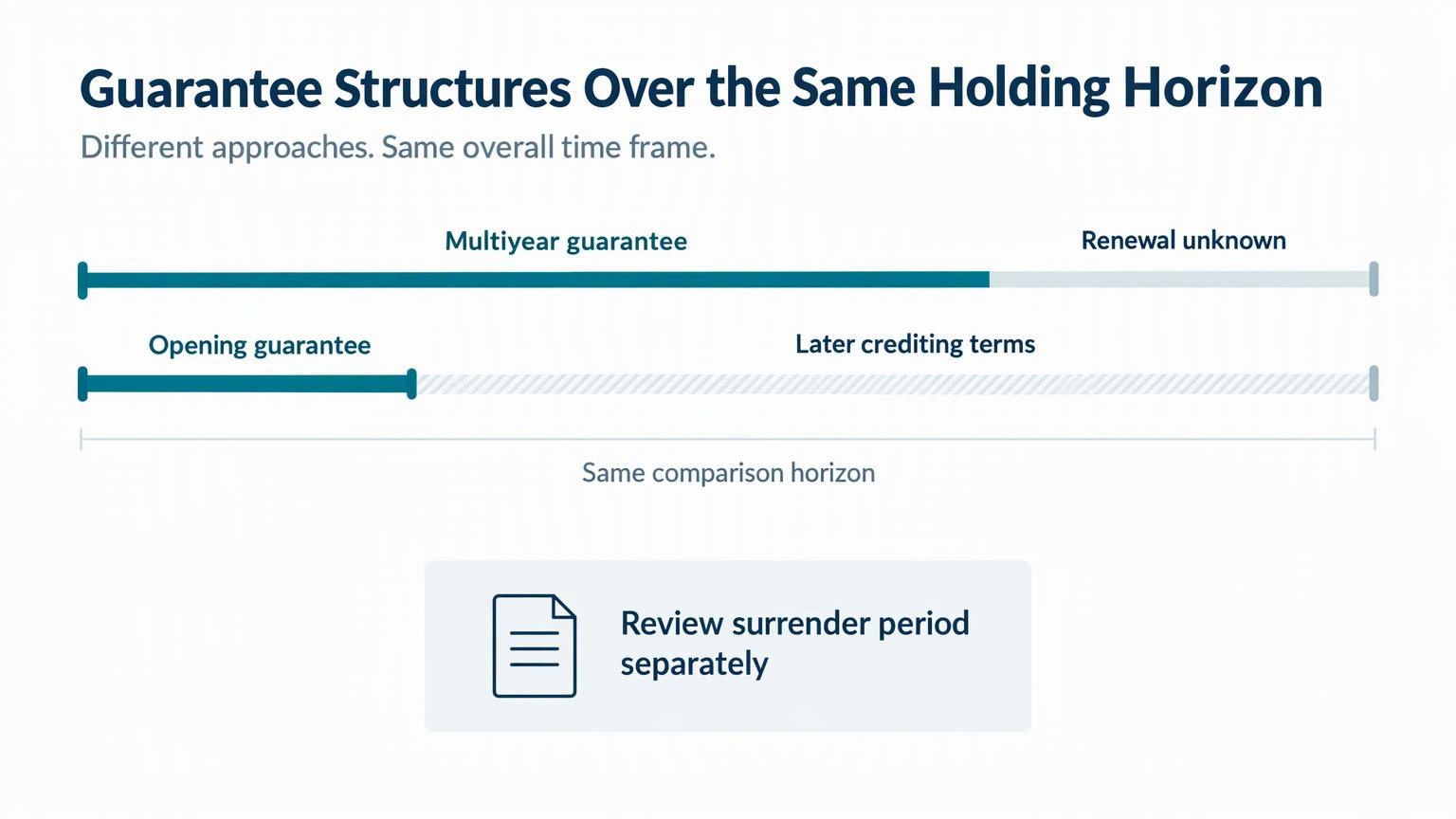
A multiyear guaranteed annuity, or MYGA, suits money you can commit when you want a stated crediting rate for a defined multiyear period. A first-year promotional rate deserves consideration only after you understand subsequent crediting terms. It does not establish a competitive return across the full holding period.
Compare both structures over the same horizon. For a MYGA, identify the guaranteed period and what happens at its end. For a promotional offer, separate the initial rate, subsequent guaranteed minimum and any nonguaranteed renewal assumption. Do not project the opening rate across every year.
A shorter interest guarantee does not necessarily mean a shorter surrender period. That distinction can leave you exposed to a renewal rate you dislike while withdrawals still carry charges.
At renewal, look for the decision window, withdrawal rights and whether continuation starts another commitment. Predictable crediting is useful, but it comes with reinvestment uncertainty when the guarantee expires. The comparison below separates those trade-offs.
| Structure | Suitable When | Main Trade-Off |
|---|---|---|
| MYGA | You want predictable crediting for a defined multiyear period. | Early access may cost money; the next term's rate is unknown. |
| First-year promotional fixed annuity | You accept later-rate uncertainty after reviewing guaranteed minimums. | The opening rate may overstate the full-period appeal. |
| Shorter guaranteed period | You prefer an earlier crediting-rate review. | Earlier rate reset does not necessarily mean charge-free access. |
How Should You Compare Surrender Charges and Market Value Adjustments?
Compare the net amount available on the same withdrawal date, not surrender-charge percentages alone. A surrender charge and a market value adjustment, or MVA, are separate contract mechanisms; both may apply to an early exit.
A surrender schedule describes the charge for withdrawals subject to it. An MVA adjusts value under a contractual formula. Investor.gov explains that contract adjustments can produce significant losses in addition to surrender charges. Determine when the adjustment applies and which withdrawals are exempt.
A charge-free withdrawal allowance also needs a defined calculation base and start date. It does not automatically eliminate taxes or every other adjustment. Ask for a net-withdrawal illustration tied to your likely access date.
Hypothetical Example: An Expense Before the Guarantee Ends
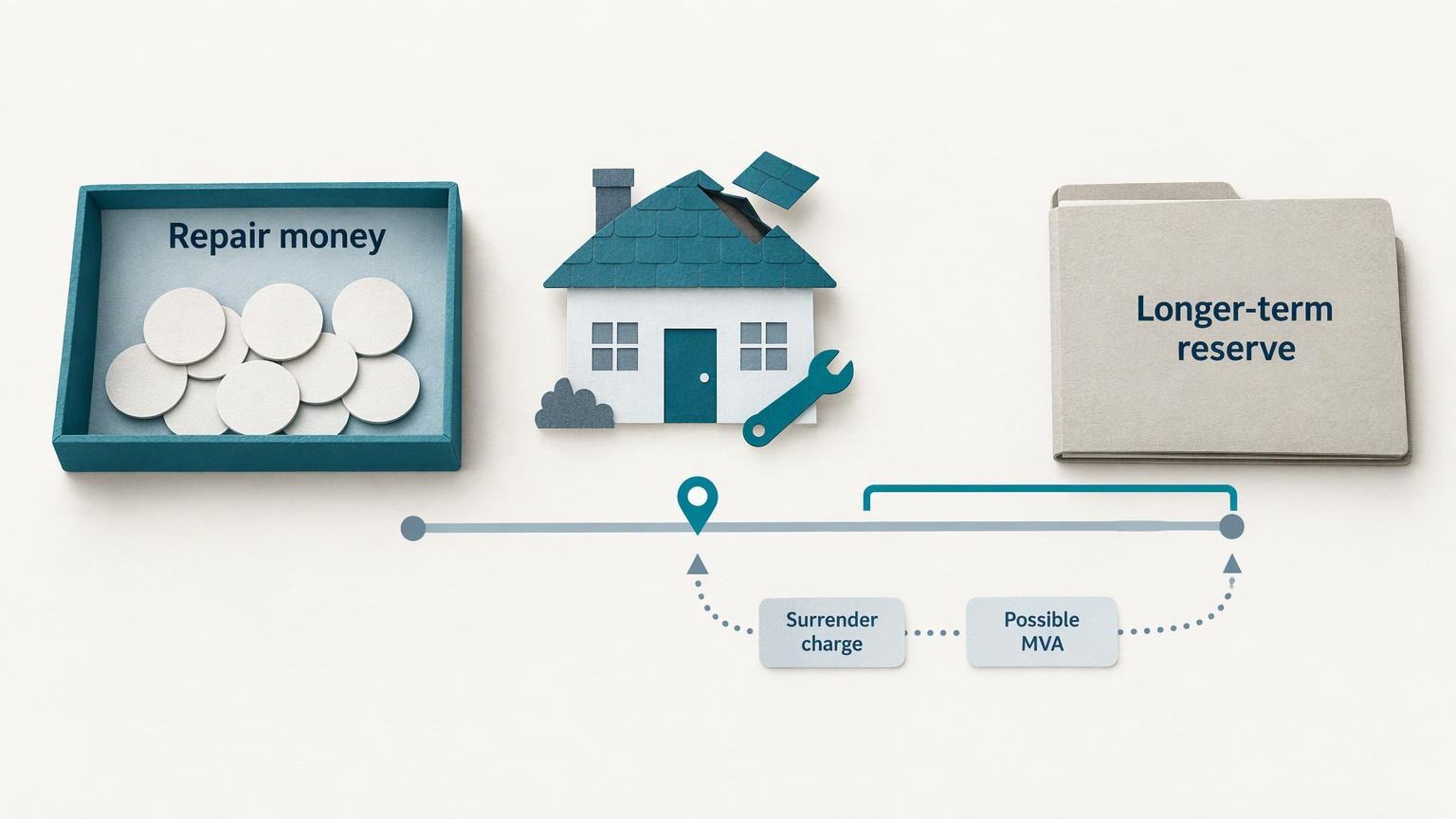
Suppose a retiree has a known home-repair expense before a proposed multiyear term ends. A longer MYGA offers more predictable crediting; a shorter commitment better matches the spending date; keeping the repair money outside the annuity preserves access.
If separate liquid savings cannot cover the expense, the longer MYGA is unsuitable for that portion unless its withdrawal provisions demonstrably cover the need. The reason is the timing constraint, not a prediction about future rates. If repairs are already funded separately, the longer guarantee can remain a reasonable choice for the retirement reserve.
Match the Guarantee to Your Spending Timeline
Discuss with Rene which portion of your retirement savings can remain committed and which needs to stay accessible.
How Do Tax Status and Income Goals Affect Fit?
Identify the source of the money and whether your goal is accumulation or spendable retirement income. Those choices determine what should be compared before the rate.
A nonqualified annuity funded outside a retirement account can provide tax-deferred accumulation, but tax deferral is not tax-free access. An annuity inside an already tax-deferred retirement account does not add another layer of tax deferral. Its justification must instead rest on useful contract features. IRAs and employer plans are different arrangements; Roth treatment is a separate tax question.
For income needs, compare payment terms rather than treating the credited interest rate as a withdrawal rate. An immediate income annuity and a deferred accumulation contract solve different problems. Payment duration, beneficiary provisions and retained access matter alongside the payment amount.
Rene's retirement planning and protection guidance addresses insurance-based planning. Use a tax adviser for distribution consequences and a plan administrator for employer-plan requirements before moving retirement money.
What Should a Dated California Quote Include?
A useful quote identifies the exact contract and the conditions under which its rate applies. Start by choosing the amount you can commit, its tax status and your required access date. Request offers on that same basis so differences reflect contracts rather than mismatched assumptions.
Keep these details together:
- Quote date, validity conditions, issuing insurer, product and California availability.
- Premium assumptions, credited rate, guarantee duration, minimum rate and interest-crediting method.
- Renewal process, decision window and any new surrender commitment.
- Surrender schedule, withdrawal allowance, MVA provisions and fees or riders.
- Beneficiary terms and, when relevant, a separate income-payment illustration.
Next, eliminate offers that fail your access requirement. Compare guaranteed outcomes among the remaining offers, then review insurer quality. The California Department of Insurance's Life & Annuity Insurance page provides company profiles, licensed-annuity-company resources and a consumer complaint study. Licensing checks and financial-strength reviews answer different questions.
Rene Farias is an independent insurance advisor who works with California clients and multiple carriers. His role is to help evaluate insurance-based options against your goals. Broader planning for business owners may also require a tax adviser, attorney or plan professional.
Work With Rene Farias
Rene Farias works with California families, professionals and business owners to compare insurance-based protection and retirement-planning strategies. He is based in Los Angeles and offers strategy sessions over Zoom.
Frequently Asked Questions
Are Fixed Annuities FDIC-Insured?
No. Annuities are insurance contracts, not FDIC-insured bank deposits, even when purchased through a bank. Their guarantees depend on contract terms and the issuing insurer's claims-paying ability. Compare insurer backing separately from the interest rate rather than assuming a fixed rate carries bank-deposit protection.
Should I Replace an Existing Annuity for a Higher Rate?
Not on the rate difference alone. Replacement can trigger existing surrender charges or adjustments and start a new surrender period. It may also give up benefits in the old contract. Compare the net transfer value and benefits retained or lost before deciding whether the new guarantee improves your position.
What Happens If I Die Before Income Payments Begin?
The contract's beneficiary provisions determine what is payable and whether charges apply. Do not assume every annuity returns the same amount under the same conditions. Review the death-benefit calculation and beneficiary options before purchase, particularly when leaving accessible funds to family is part of your goal.
Do California Seniors Have Time to Review an Annuity After Delivery?
Yes. California Department of Insurance guidance states that seniors have a 30-day free-look period and can return the annuity contract for a full refund during that period. Read the contract's return instructions promptly. This review opportunity is not the same as ongoing charge-free withdrawal rights.
Does a Guaranteed Fixed Rate Protect Against Inflation?
No. A guaranteed nominal rate establishes contractual crediting, not future purchasing power. Your expenses can rise faster than the interest credited. Consider the annuity's role within your broader retirement resources rather than assuming predictable account growth will keep pace with every future increase in living costs.
Compare Your Quotes Against Your Retirement Needs
Use a strategy session with Rene Farias over Zoom to discuss your dated proposals, intended holding period and income goal. Focus on the contract that fits your plan, not simply the advertisement with the highest rate.