
How Much Life Insurance Do I Need? California Calculator Guide
Estimate your life insurance need by adding debts you want paid, future household income gaps and other planned expenses, then subtracting available savings and existing usable coverage. Match the coverage duration to how long those needs last. Calculate the death benefit first; a premium quote answers a separate question.
If you began by searching how much life insurance costs, start with what the policy must accomplish. A monthly premium means little without a coverage amount and timeline. This California guide provides a worksheet you can use privately, not an interactive calculator or a personalized insurance quote.
Key Considerations
- Count mortgage payoff or ongoing mortgage payments, not both.
- Deduct only resources available for the same people and purpose.
- A new coverage estimate does not automatically justify replacing an existing policy.
Which Debts And Future Income Needs Should You Include?
Include obligations you want the death benefit to fund, plus the shortfall your household would face without your income or unpaid work. Use the surviving household's expected budget rather than simply multiplying your salary.
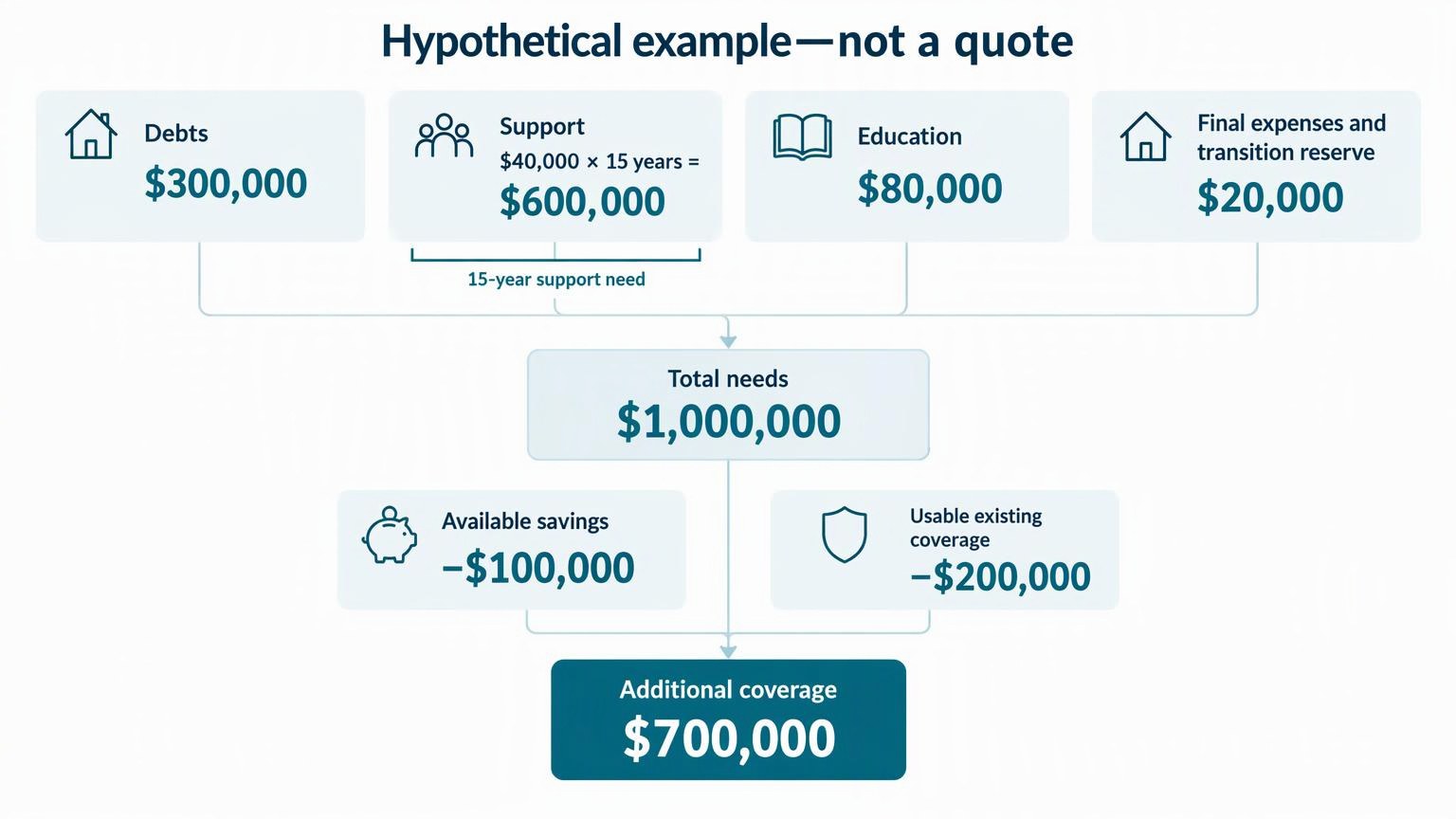
Additional coverage estimate = immediate obligations + future support + other goals − available resources − usable existing coverage.
Immediate obligations can include a mortgage payoff, other debts and final expenses. Future support includes living expenses, childcare and replacement help, less dependable income the survivor expects to receive. Education funding or support for another dependent belongs in a separate goal amount.
Avoid double counting: if you include mortgage payoff, remove those mortgage payments from future living expenses. If the survivor would keep making payments instead, include them in the support budget rather than adding the full loan balance.
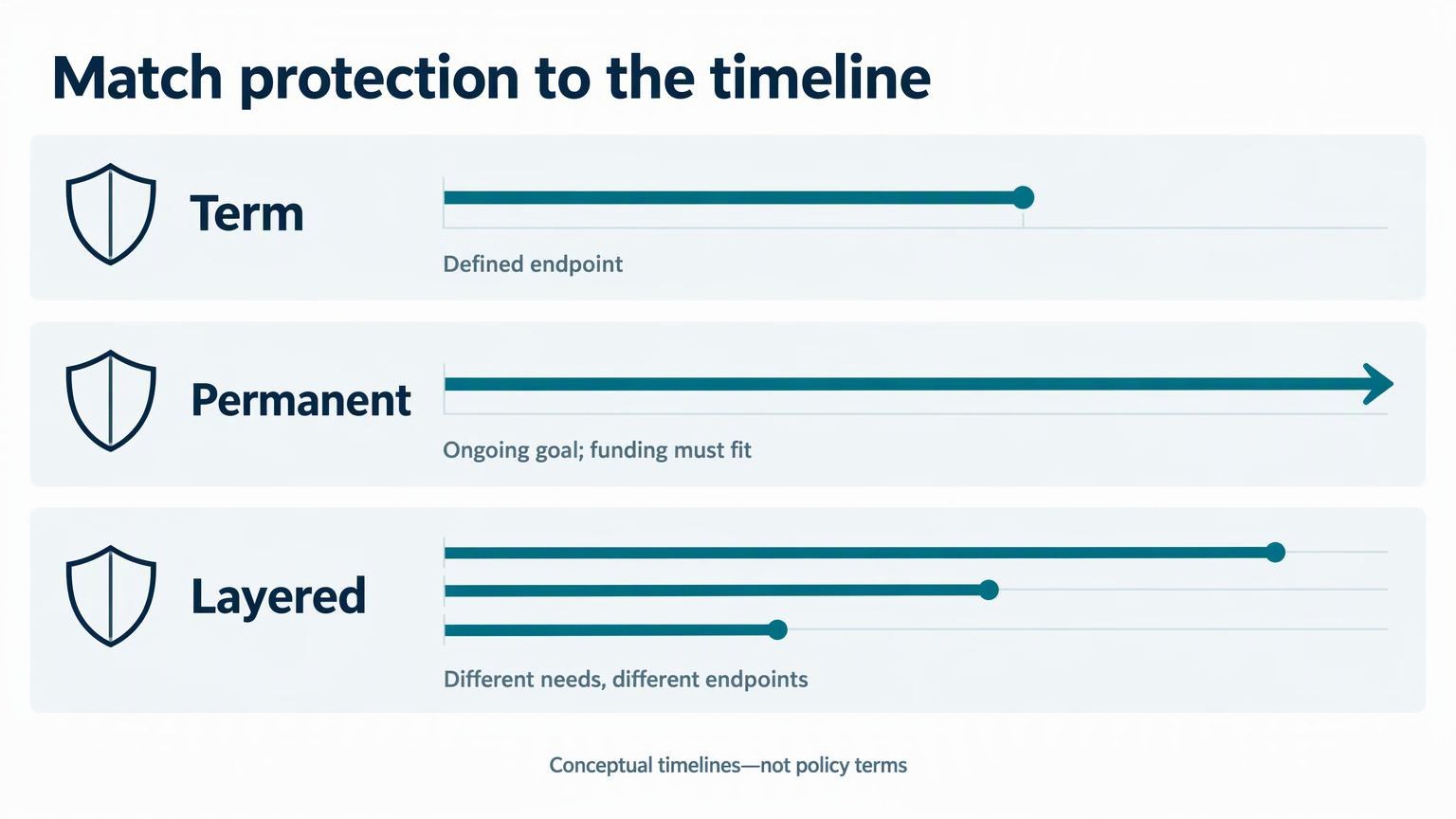
Assign an end date to each need. A child's dependency period and a mortgage may end at different times; a lifelong dependent may require a longer planning horizon. These dates help distinguish temporary protection from an ongoing coverage need.
Which Savings And Existing Policies Can Reduce The Estimate?
Subtract assets and coverage only when they are available to the intended survivors and assigned to the needs you just calculated. An account balance is not automatically spendable protection money.
Decide how much accessible savings the household could use without exhausting its emergency reserve. Keep education funds allocated to education; do not also subtract them from income replacement. Treat retirement assets cautiously when access, taxes or the survivor's own retirement needs would limit their use. Home equity should not substitute for income unless selling or borrowing against the home is part of the actual plan.
For existing insurance, identify the death benefit, beneficiary, remaining duration and any policy provisions that could reduce the payout. Do not automatically add cash value to the death benefit; the contract determines what beneficiaries receive.
Employer coverage deserves a separate check because its continuation depends on the plan's terms. Likewise, coverage intended for business succession should not be treated as family protection unless its ownership, beneficiary and purpose support that use.
| Approach | Suitable When | Trade-Off |
|---|---|---|
| Term coverage | Income replacement or debt protection has a defined endpoint. | Protection ends according to the contract; examine any later renewal or conversion terms. |
| Permanent coverage | You have an ongoing protection goal and can sustain the required funding. | Longer-term funding and policy-value provisions require careful review. |
| Layered coverage | Some needs end earlier than others. | Different expiration dates can fit changing needs but require more tracking. |
How Does A Household Work Through The Calculation?
Add the needs, subtract the usable offsets, then test whether the result supports the household's required timeline. The following figures are entirely hypothetical and are not a recommendation or quote.
Assume a household wants its mortgage paid off and needs ongoing support for a fixed 15-year dependency period:
- Mortgage payoff and other debts: $300,000.
- Annual household shortfall after survivor income, excluding mortgage payments: $40,000 × 15 years = $600,000.
- Education goal: $80,000.
- Final expenses and transition reserve: $20,000.
Total needs are $1,000,000. Subtract $100,000 in savings available for these goals and $200,000 of existing coverage assumed to remain usable throughout the period. The additional coverage estimate is $700,000.
Using only 10 years of support would reduce the estimate to $500,000, but would leave five years of the stated need unfunded. With the dependency period fixed, shortening the calculation merely to reach a smaller number is not a sound solution.
The household should first compare protection lasting through that period. If premiums exceed its budget, it can explicitly reconsider debt payoff or education goals rather than silently remove necessary support. This simple arithmetic assumes no inflation or investment return; test those assumptions before treating it as a final target.
Discuss Your Coverage Gap
Use a Zoom strategy session with Rene Farias to review which obligations and resources belong in your estimate.
When Should You Recalculate Your Coverage Need?
Recalculate when a change affects your household expenses, available resources or protection timeline, and make coverage review part of your regular financial planning. A larger salary alone does not establish a larger need; the survivor's expected shortfall is what matters.
Use this short review checklist:
- A birth, marriage, divorce or new dependent changes who needs support.
- A home purchase or debt payoff changes obligations.
- A job change affects income or employer coverage.
- Retirement or a dependent becoming self-supporting changes duration.
- A business ownership change may require a separate business calculation.
Update the worksheet and beneficiary arrangements together. If the estimate rises, compare supplementing existing protection with other options. If it falls, assess whether the policy still serves another intended purpose before reducing it.
The California Department of Insurance cautions that replacement can involve new startup costs, higher premiums and a new contestability period. Do not cancel existing protection while a proposed replacement is still unresolved. Legal documents and business arrangements require the relevant attorney or tax adviser, not just an insurance discussion.
Work With Rene Farias
Rene Farias works with California families, professionals and business owners to compare insurance-based protection and retirement-planning strategies. He is based in Los Angeles and offers strategy sessions over Zoom.
Frequently Asked Questions
Does A Stay-At-Home Parent Need Life Insurance?
Unpaid work can create a financial need even without a salary. Estimate the childcare, transportation and household help the survivor would need to replace, then subtract help or resources genuinely available. Calculate each parent's protection separately rather than assigning identical amounts solely because they share a household.
Should I Automatically Buy Coverage Equal To A Multiple Of My Salary?
A salary multiple can be a rough screening tool, but it does not reveal the survivor's actual budget. It may overlook unpaid caregiving or exaggerate needs when substantial resources are available. Use the expense-based worksheet for the decision, with a salary multiple only as a secondary reasonableness check.
Is The Death Benefit Taxable To My Family?
The IRS says proceeds received because of the insured's death generally are not included in a beneficiary's gross income. Interest is taxable, and transfers for valuable consideration can limit the exclusion, subject to exceptions. Estate inclusion is a separate question; consult a tax adviser for unusual ownership arrangements.
What If My Worksheet Produces A Negative Coverage Gap?
A negative result means the resources you counted exceed the needs you listed under those assumptions. It does not mean you should buy a negative amount or immediately cancel insurance. Check asset availability, beneficiary access and omitted goals before deciding whether additional protection is unnecessary for that particular purpose.
Can Life Insurance Replace Disability Or Long-Term Care Coverage?
Not automatically. This worksheet estimates financial needs following death, not income loss during disability or extended care expenses. Some life policies offer accelerated benefits under specific conditions, but those provisions are not interchangeable with comprehensive disability or long-term care protection. Evaluate those risks and policy terms separately.
Compare Policies Against Your Amount And Timeline
Once your worksheet is ready, discuss coverage duration, sustainable premiums and existing protection with Rene Farias over Zoom. Use the session to compare insurance options; the insurer determines underwriting and offered terms.