
Life Insurance Retirement Plan (LIRP): How It Works
A life insurance retirement plan, or LIRP, is a strategy that uses permanent life insurance cash value to supplement retirement income, not a separate qualified retirement plan. Consider it when you need lasting coverage and can sustain funding; prioritize conventional retirement savings and simpler coverage when liquidity or affordability comes first.
For California families, professionals and business owners, the useful question is what remains after insurance costs and how dependable future access could be. A persuasive illustration is not enough: the policy must still work when funding, crediting or borrowing differs from the original assumptions.
Key Considerations
- Evaluate the insurance contract, not the LIRP or TFRA marketing label.
- Choose an access method with its interest, benefit and tax consequences in mind.
- Test funding durability and competing savings needs before committing premiums.
What Does a Life Insurance Retirement Plan Mean?
A LIRP describes using permanent life insurance for both death-benefit protection and potential supplemental income from cash value. You purchase an insurance contract, not a new IRS retirement-account category. The name does not create contribution deductions or Roth-style withdrawal rights.
The intended sequence is to fund the policy, allow value to accumulate, and later access available value under its terms. Those steps require sufficient funding and continued coverage; they are not a promise of a retirement paycheck.
Keep the vocabulary separate. Indexed universal life, or IUL, is a policy type. LIRP is a planning strategy. TFRA is another marketing term for a permanent-life-insurance strategy, not a bank account or distinct qualified plan. Supplemental life insurance offered through an employer is also not automatically a LIRP. The underlying policy must actually provide cash value and suitable access provisions.
Which Policy Components Support Cash-Value Access?
Potential access depends on accumulated cash value, the policy's loan and withdrawal provisions, and the cost of maintaining the death benefit. Premium payments do not translate dollar for dollar into spendable savings: insurance costs and other charges affect what remains.
Distinguish cash value from cash surrender value, the amount available on termination after applicable surrender charges and obligations. A projected balance alone does not tell you what you can safely access while keeping coverage in force.
For IUL, interest crediting depends partly on an index, but you do not directly own index investments. Caps, participation rates and spreads depend on contract terms and may change. Pacific Life's IUL explanation specifically notes that charges, loans and withdrawals can reduce value despite a crediting floor.
Compare guaranteed and nonguaranteed values separately. Contractual guarantees depend on policy conditions and the issuing insurer's claims-paying ability; they are not FDIC-insured bank guarantees.
| Approach | Suitable Situation | Reason | Trade-Off |
|---|---|---|---|
| Term coverage plus separate saving | Temporary protection need or constrained cash flow | Separates coverage from retirement accumulation | Term coverage does not build cash value |
| Employer plan or IRA | Retirement saving is the primary goal | Uses a retirement-specific arrangement | Eligibility, contribution and distribution rules apply |
| Permanent insurance with a LIRP strategy | Lasting coverage need and durable surplus funding | Combines protection with potential supplemental access | Policy costs, tax conditions and ongoing monitoring matter |
How Do Loans and Withdrawals Differ?
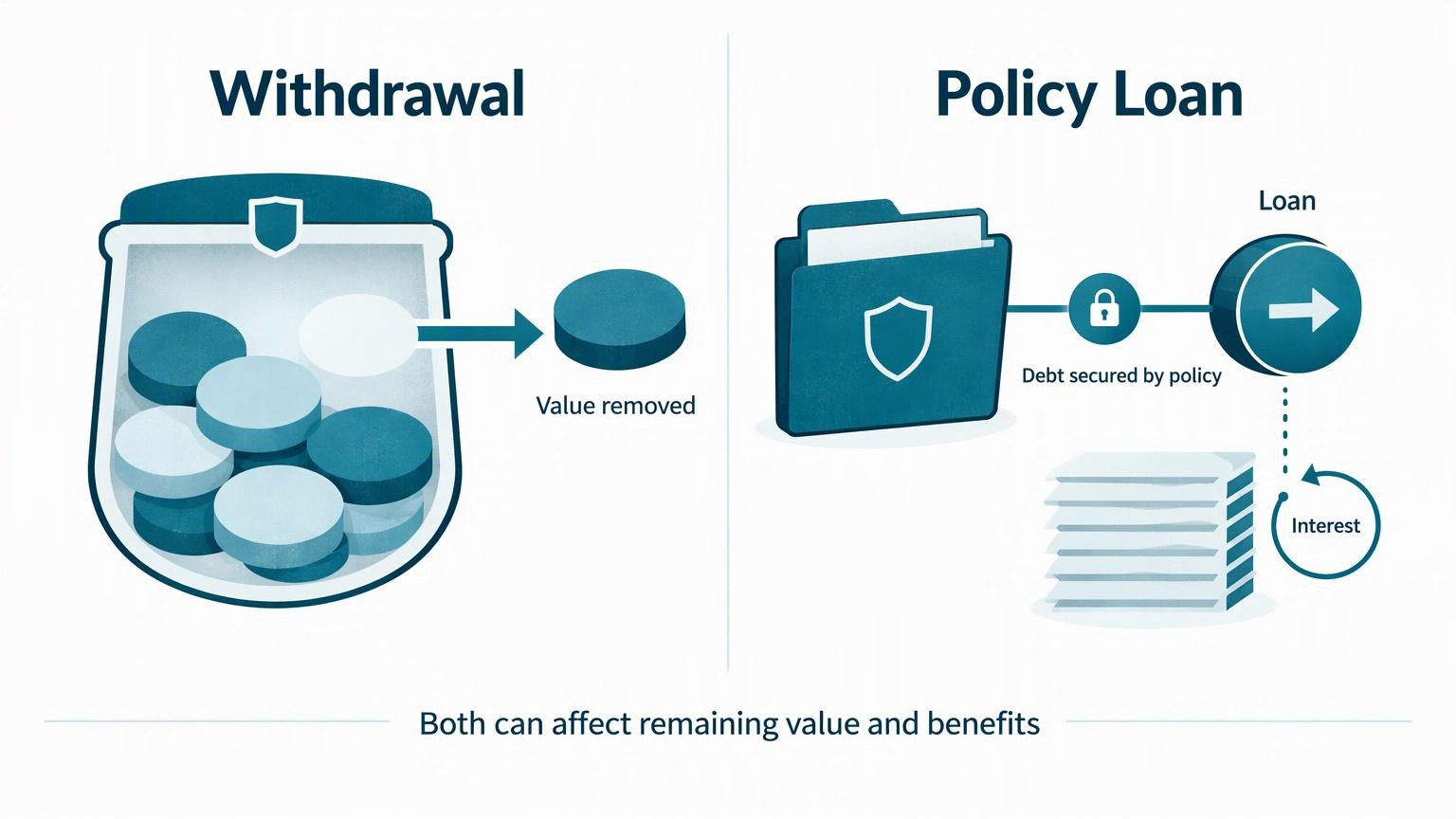
A withdrawal removes policy value. A policy loan creates a debt secured by the policy and carries interest. Both can affect what remains for future income and beneficiaries, but their mechanics and tax treatment differ.
For a non-MEC life insurance contract, withdrawals generally recover your investment in the contract, often called tax basis, before taxable gain, subject to applicable exceptions. Basis is not necessarily the total premiums ever paid because previous transactions can affect it. A withdrawal can reduce cash value and the death benefit under the policy's terms.
A loan from a qualifying non-MEC policy generally is not included in federal taxable income when taken while the policy remains in force. That does not make borrowing cost-free or permanently tax-free. Unpaid interest can increase debt, and outstanding obligations reduce the net benefit available.
Full surrender ends coverage rather than creating ongoing income access. Proceeds exceeding investment in the contract can be taxable. These distinctions follow Internal Revenue Code section 72; your tax adviser should assess the actual transaction.
Understand Your Policy's Access Options
Discuss how loans and withdrawals could affect an existing or proposed insurance strategy with Rene Farias over Zoom.
What Can MEC Status, Interest or Lapse Change?
MEC status changes distribution taxation, while accumulated interest and lapse can undermine the policy's ability to support future access. These are separate issues: avoiding MEC status does not eliminate loan or lapse risk.
A modified endowment contract, or MEC, is subject to funding rules under section 7702A. Premium patterns and certain benefit changes matter. For a MEC, distributions generally come from taxable gain first, and loans are treated as distributions. Under section 72, the taxable portion can also face a 10 percent additional federal tax before age 59½ unless an exception applies.
If interest is added to a loan balance, debt can grow even without further borrowing. A lapse or surrender with outstanding debt can create taxable income without a matching cash payment.
Use a recurring review process: obtain current values and an in-force illustration, compare actual results with assumptions, then test lower crediting and higher loan balances. If coverage becomes less sustainable, evaluate reduced borrowing, interest payments or additional funding before requesting more income.
When Should Retirement Accounts or Simpler Coverage Come First?
Conventional retirement savings and simpler coverage should generally come first when you need accessible reserves, have a temporary protection need or cannot comfortably sustain permanent-policy funding. A LIRP deserves evaluation when lasting insurance has an independent purpose and supplemental savings can remain committed for the long term.
Assess available employer-plan opportunities, IRA eligibility and your tax circumstances before redirecting savings. Employer-qualified plans and IRAs are distinct arrangements, and Roth describes tax treatment rather than making every account an employer-qualified plan. Compare these alternatives alongside life insurance coverage options, rather than treating insurance as a universal replacement.
A Hypothetical Funding Decision
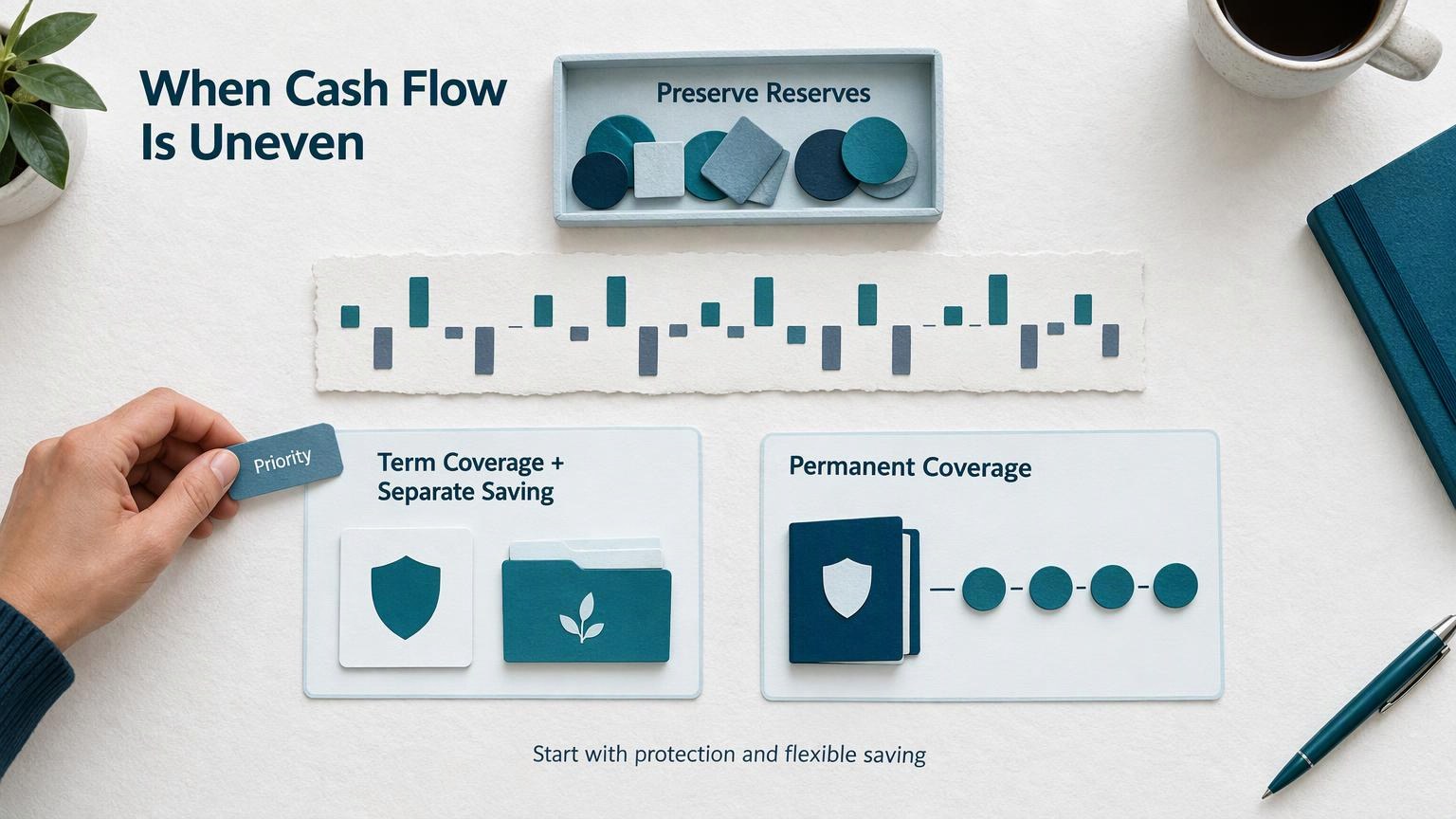
Suppose a business owner needs family protection but has uneven income and must preserve reserves for operations. The alternatives are permanent coverage intended for future cash-value access or term coverage paired with separate retirement saving. The fixed constraint is unreliable surplus cash. Term coverage and flexible saving are the stronger starting point because the owner should not depend on sustained permanent-policy funding that the business cannot reliably support.
Turn the Comparison Into a Planning Discussion
Prepare your coverage purpose, sustainable premium budget, access timeline and existing-policy information. Rene Farias is an independent insurance advisor based in Los Angeles who works with California clients and multiple carriers, with strategy sessions over Zoom. Rene can help compare insurance-based options; tax advisers and relevant plan professionals handle tax analysis, retirement-plan eligibility and administration.
Work With Rene Farias
Rene Farias works with California families, professionals and business owners to compare insurance-based protection and retirement-planning strategies. He is based in Los Angeles and offers strategy sessions over Zoom.
Frequently Asked Questions
Can I Use a Policy I Already Own?
Possibly, if it has cash value and suitable access provisions. Start with its current statement and an in-force illustration, not the original sales projection. Existing loans, surrender charges and tax basis affect the evaluation. Do not assume replacement is necessary merely because another policy is marketed as a LIRP.
Does a LIRP Guarantee a Retirement Paycheck?
No. An illustrated stream of loans or withdrawals is not automatically a guaranteed income benefit. It depends on available value, charges, funding and access assumptions. Identify exactly which values the contract guarantees and whether the proposed income schedule relies on nonguaranteed results before using it in a retirement budget.
Are Life Insurance Death Benefits Always Tax-Free?
No. The IRS explains that death proceeds generally are excluded from beneficiaries' gross income, but interest is taxable and transfer-for-value rules can limit the exclusion. Federal income-tax treatment and estate inclusion are different questions. Ownership or estate-planning changes require appropriate tax and legal advice, not just an insurance illustration.
Can I Add a Large Premium Whenever I Have Extra Cash?
Do not assume every additional payment can be accepted without consequences. The insurer must evaluate the contract's funding limits and MEC implications, including relevant benefit changes. Before sending an unusually large payment, request a policy-specific assessment of how it would affect tax status and the intended access strategy.
Is a LIRP the Same as an Annuity?
No. This strategy centers on a life insurance contract with death-benefit protection and potential cash-value access. An annuity is a different insurance contract used for accumulation or income purposes. A loan-based LIRP illustration should not be mistaken for an annuity's contractual income-payment provisions. Compare the actual benefits being purchased.
Decide Whether Permanent Coverage Fits Your Retirement Plan
Use your next strategy session to compare the purpose of lasting coverage with your funding capacity and supplemental-income goals. Bring existing-policy information if relevant so the discussion starts with the contract you have, not just the strategy's name.