
Life Insurance With Living Benefits: What It Is and How It Works
Life insurance with living benefits can let you receive part of the death benefit while alive if you meet a policy's qualifying illness conditions. Consider these riders for supplemental flexibility, but compare separate long-term care coverage if extended care is your main concern. Acceleration can reduce what remains for beneficiaries.
For California families, professionals and business owners, the useful question is not simply whether a policy advertises living benefits. It is whether the contract addresses the health risk you want to fund while preserving the protection others depend on. Start with the benefit mechanism, then examine eligibility, financial effects and alternatives.
Key Considerations
- Match the illness trigger to the risk you want covered, not just the rider's name.
- Evaluate the remaining death benefit before accepting an accelerated payment.
- Compare comprehensive long-term care coverage when extended-care services are the main priority.
What Do Living Benefits Mean on a Life Insurance Policy?
In this context, living benefits mean provisions that allow an eligible insured's death benefit to be paid early because of a qualifying illness. The provision may be included in the policy or added through a rider. Not every policy includes every benefit.
The California Department of Insurance's Life Insurance Guide describes an accelerated benefit provision as allowing early receipt of part of the death benefit when the insured is diagnosed with a terminal illness or permanently confined to a nursing home. The actual contract, rather than a marketing label, establishes your rights.
Acceleration is different from borrowing against cash value or making a withdrawal. Those transactions access a permanent policy's value; illness acceleration depends on meeting its qualifying conditions. A cash-value balance alone does not establish eligibility for an illness benefit.
Choose the underlying coverage for its protection purpose and sustainable funding first. Rene's California life insurance guidance provides context for that broader policy decision.
How Do Terminal, Chronic and Critical Illness Provisions Differ?
The distinction is the qualifying event: terminal illness focuses on prognosis, chronic illness on qualifying functional or cognitive impairment, and critical illness on specified diagnoses or events. These are different routes to eligibility, not interchangeable labels.
- Terminal illness: Look for the contract's life-expectancy definition and required medical certification. A serious diagnosis is not automatically a terminal-illness qualification.
- Chronic illness: Examine the definitions governing assistance with daily activities or cognitive impairment, along with duration and certification requirements. A long-lasting condition alone does not establish eligibility.
- Critical illness: Read the covered-condition list and each definition. A familiar disease name may have severity criteria that determine whether a claim qualifies.
A provision covering terminal illness does not necessarily address an extended period of nonterminal care. Likewise, a critical illness provision should not be treated as coverage for every condition that prevents you from working. Compare the trigger with the financial risk you actually want to address.
| Approach | Consider When | Main Trade-Off |
|---|---|---|
| Life insurance with acceleration | Survivor protection is primary; illness access is supplemental. | Using the benefit can reduce the family's eventual payout. |
| Separate comprehensive long-term care insurance | Extended-care services are the main funding concern. | Requires a separate premium commitment and review of care limits. |
| Life insurance plus separate care coverage | Both survivor protection and extended-care funding are important. | Broader planning requires coordinating affordability and benefit terms. |
Match the Rider to Your Protection Goal
Discuss with Rene Farias which illness provisions deserve comparison for your family or business, alongside the underlying life insurance coverage.
How Does Acceleration Affect the Remaining Policy?
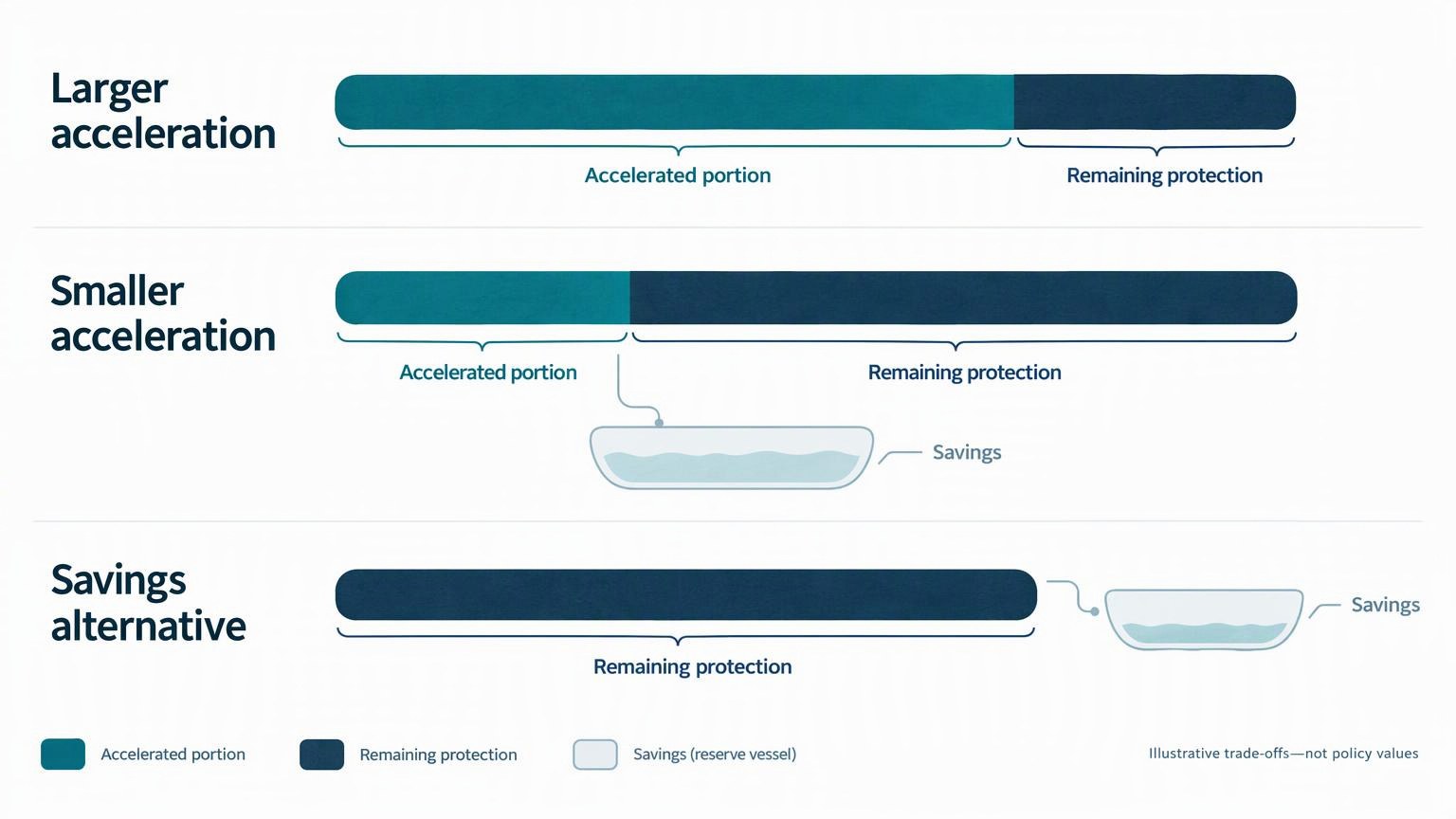
Acceleration uses a benefit that otherwise would be payable at death, so it can leave less for beneficiaries. For permanent insurance, also examine any effect on cash value, outstanding loans, premiums and other policy provisions.
Distinguish the amount of death benefit accelerated from the cash actually offered. Do not assume the payment and the death-benefit reduction are identical. The insurer's benefit calculation should show the net payment, applicable adjustments and remaining coverage. Confirm what payments are needed to keep that remaining coverage in force.
Hypothetical Example: Preserve Essential Survivor Protection
Suppose you qualify for acceleration, need funds for an illness-related expense, and must preserve enough insurance for a dependent's essential support. Your alternatives are accepting the maximum offered benefit, requesting a smaller acceleration if permitted, or using available savings.
If maximum acceleration would leave inadequate survivor protection, it conflicts with your fixed constraint. A smaller election combined with savings may fit better, provided it does not exhaust essential reserves. If no affordable combination works, the rider has not solved both needs. Qualification alone is not a reason to accept the maximum payment.
When Is Comprehensive Long-Term Care Insurance the Better Comparison?
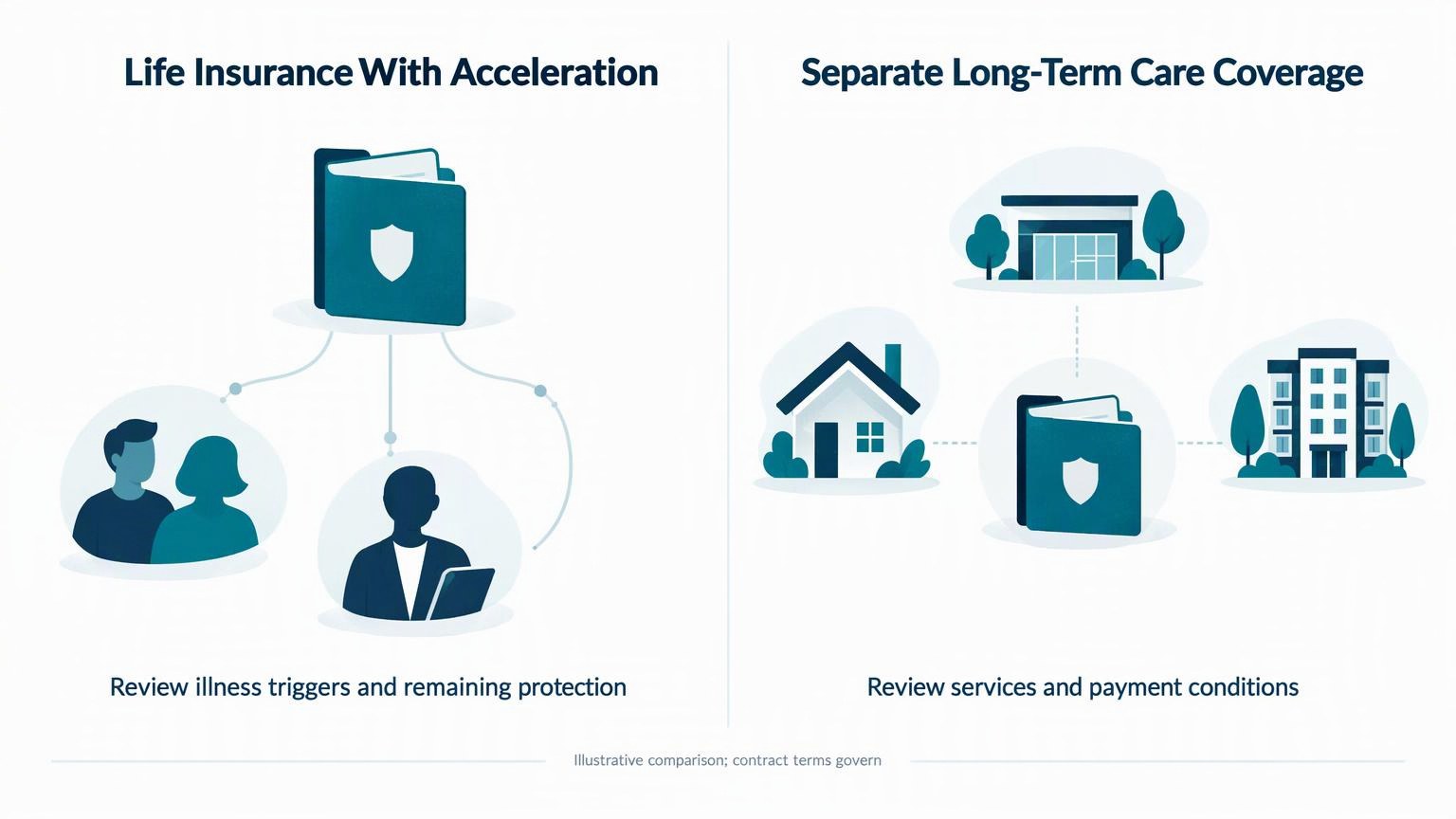
Compare comprehensive long-term care insurance when your main concern is paying for extended care across different settings. Compare accelerated benefits when your priority is life insurance with additional illness-related access to its death benefit. Neither approach wins solely because it includes more features.
The California Department of Insurance's Long Term Care Insurance guide explains that meeting a long-term care policy's benefit triggers is not the final step: additional payment conditions apply. A required plan of care describes the care needed and the frequency of services; many policies require periodic updates.
A chronic illness acceleration rider is not automatically comprehensive long-term care coverage. Similar eligibility language does not establish identical covered services or benefit duration. Some insurance designs combine life and care benefits, but the actual provisions still matter.
If you want to protect savings from care expenses without relying entirely on reducing survivor coverage, compare the long-term care insurance options alongside your life policy, rather than assuming one replaces the other.
Which Exclusions and Claim Conditions Should You Compare?
Compare the actual rider's eligibility language, limitations and payment calculation. A benefit name cannot tell you whether a particular illness qualifies or how much money would be available.
Use this compact checklist when reviewing proposals:
- Eligibility: Covered conditions, severity or duration standards, and required medical certification.
- Restrictions: Exclusions, waiting or survival requirements, and any preexisting-condition limitations.
- Payment: Acceleration limits, calculation method, charges or discounts, and permitted use of proceeds.
- Policy aftermath: Remaining death benefit, cash value, loans, premiums and interaction with other riders.
For a potential claim, first contact the insurer for the applicable forms and requirements. Obtain the required medical documentation, submit the claim, and review the insurer's eligibility decision and benefit calculation. Before electing payment, assess the remaining policy against your family's needs.
Rene Farias can help you compare insurance-based protection options over Zoom; the insurer determines claims under its contract. Have a tax adviser review the payment's treatment. Internal Revenue Code Section 101(g) provides special treatment for certain accelerated death benefits, not a universal tax-free rule. Attorney involvement is appropriate when ownership or business agreements affect the decision.
Work With Rene Farias
Rene Farias works with California families, professionals and business owners to compare insurance-based protection and retirement-planning strategies. He is based in Los Angeles and offers strategy sessions over Zoom.
Frequently Asked Questions
Does an Included Rider Mean There Is No Cost to Use It?
No. Whether a rider has a separate premium is different from how an accelerated payment is calculated. Review any payment adjustments and the resulting reduction in coverage. An included feature should not be interpreted as an extra pool of money that leaves the original death benefit untouched.
Can I Add Living Benefits to a Policy I Already Own?
Do not assume you can. Availability depends on your insurer, policy and permitted changes. Start with the existing contract and ask whether an addition is possible and whether underwriting applies. If replacement is proposed, compare what you would lose as well as what the new policy offers.
Do Living Benefits Replace Disability Income Insurance?
No. Illness acceleration depends on the life policy's qualifying health conditions, not simply your inability to earn income. Disability income insurance addresses a different protection need under its own disability definition and payment rules. A professional or business owner should evaluate the income gap separately from illness-related lump-sum needs.
Does the Policy's Cash Value Determine Whether I Qualify?
Not by itself. Cash value and illness eligibility are different contract features. The relevant illness provision determines qualification, while the policy and rider determine how payment affects remaining values. Avoid treating a cash-value illustration as evidence that an accelerated illness claim would be approved or paid in a particular amount.
What If My Business Owns the Policy?
Policy ownership changes whose interests and agreements must be reviewed. Do not assume a business-owned policy provides the same personal access or tax result as individually owned coverage. Coordinate the proposed election with the insurer, your tax adviser and, where business agreements are involved, your attorney before proceeding.
Decide How Much Protection Must Remain
Identify the survivor protection you need to preserve and the illness or care expense you want to fund. Use a strategy session with Rene Farias over Zoom to compare those priorities against your current policy or proposed coverage.