
Long-Term Care Insurance in California: 2026 Complete Guide
Compare traditional and dedicated linked-benefit coverage when seeking a long-term care insurance quote in California, even if your legacy insurance is already sufficient. Traditional coverage emphasizes care protection; linked-benefit designs can add predictable funding and remaining benefits. Choose using matched care benefits, contractual premium terms and a budget that preserves essential reserves.
Extended personal assistance creates a different expense from medical treatment. Medicare does not pay for long-term custodial care, including most nonmedical help at home or in a facility. Your planning task is to decide which expenses to insure, which to fund yourself and which assets should remain available for other purposes.
Key Considerations
- Existing legacy insurance does not rule out a dedicated linked-benefit care policy.
- Guaranteed renewability protects continuation of coverage, not necessarily unchanged premiums.
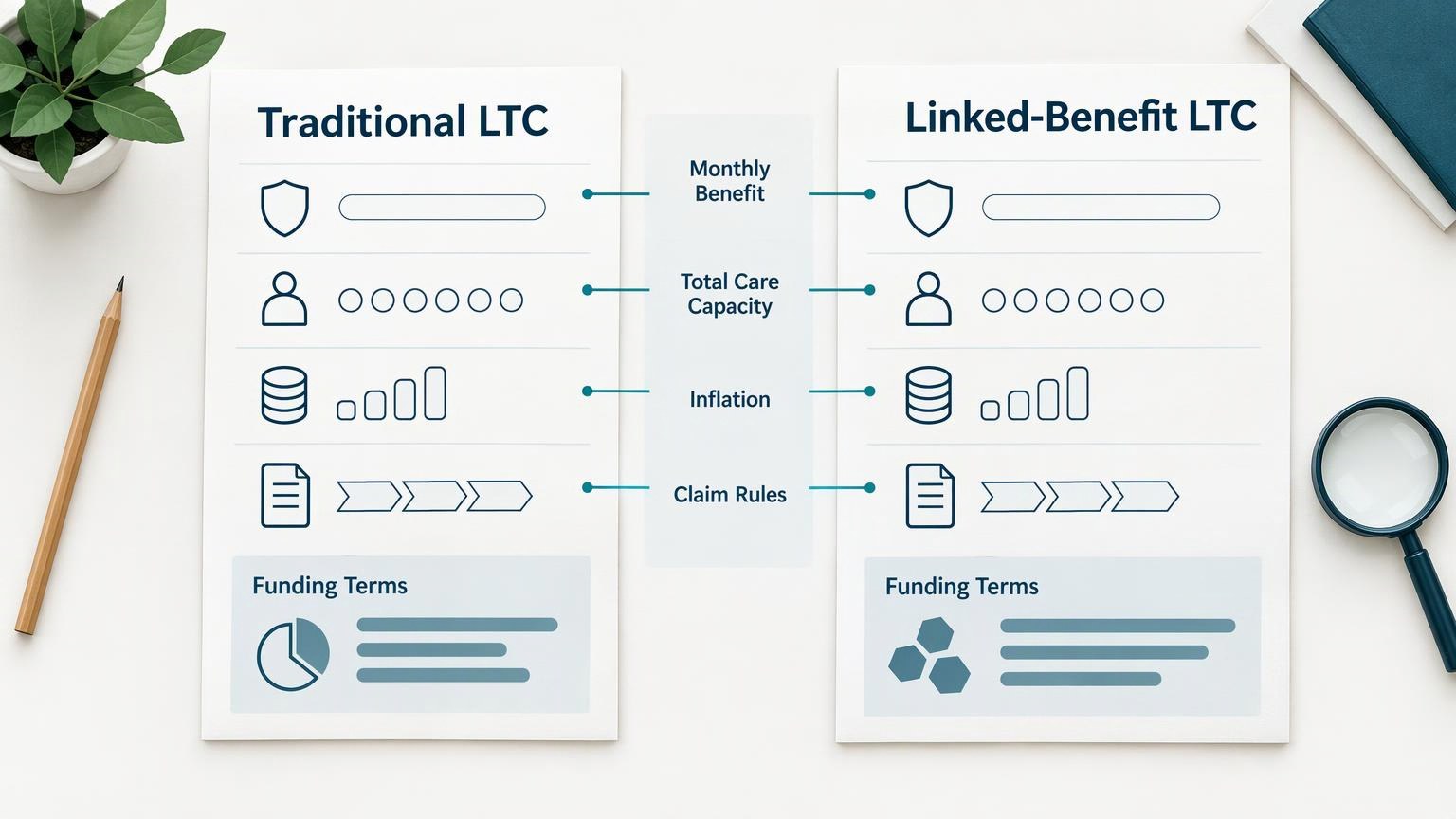
- Match monthly benefits, total capacity and inflation before comparing funding costs.
Choose Care Funding Independently Of Your Legacy Needs
Consider both traditional and linked-benefit insurance for care protection. You do not need an additional legacy objective for a dedicated linked-benefit policy to deserve consideration.
Traditional LTC insurance focuses on qualifying care expenses. A linked-benefit life/LTC design can combine care coverage with a death benefit and, in some contracts, an extension of care benefits beyond the amount available through death-benefit acceleration. The NAIC Shopper's Guide explains these structures and notes that traditional coverage can cost less than hybrid coverage when other benefits are equal.
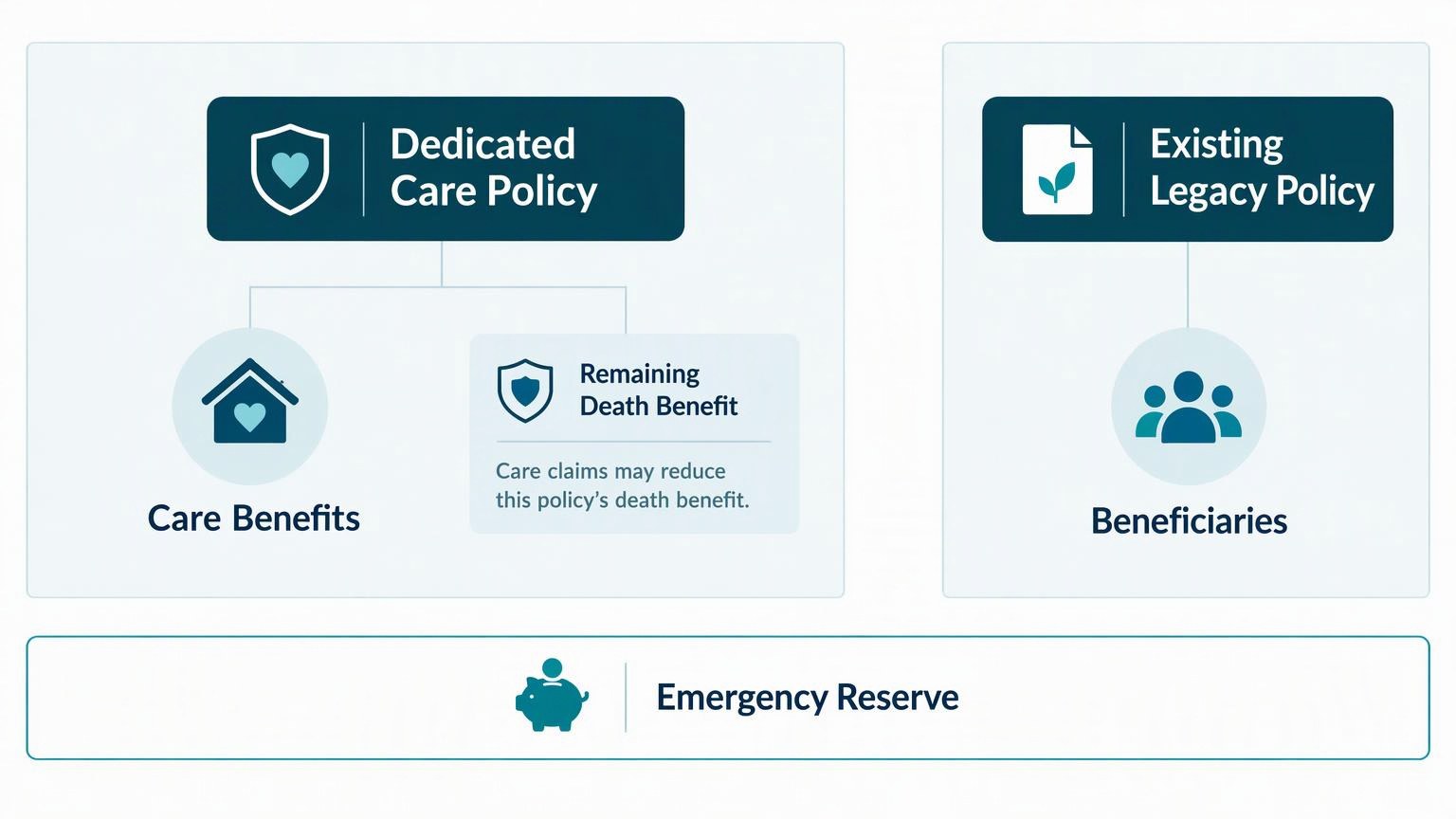
A linked policy's death benefit can be secondary to its care purpose. Your separate life insurance protection may continue serving family or legacy obligations while the dedicated policy addresses care.
Self-funding remains reasonable if available income and assets can absorb uncertain care expenses without disrupting retirement commitments. Insurance is not the better choice when its premiums would displace essential spending.
| Approach | Suitable When | Reason | Trade-Off |
|---|---|---|---|
| Traditional LTC | You want care-focused insurance. | Compare the cost of matched care protection without bundled legacy benefits. | Premium increases may affect ongoing affordability. |
| Dedicated Linked-Benefit Life/LTC | You value care funding with supported contractual premium guarantees. | Can complement an existing legacy policy rather than replace it. | Funding and surrender access depend on the design; claims can reduce its own death benefit. |
| Intentional Self-Funding | You can absorb care expenses while preserving other commitments. | Retains control of assets without an insurance premium obligation. | You bear the expense and duration risk. |
Keep Dedicated Care Coverage Separate From Earmarked Legacy Protection
Separate policies can give care and legacy funding distinct jobs. Care payments from a dedicated linked policy may reduce that policy's own death benefit and cash surrender value; they do not, by themselves, draw benefits from an unrelated legacy policy.
Hypothetical scenario: A California household already has life insurance earmarked for beneficiaries. Its fixed constraints are a sustainable ongoing premium budget and an emergency reserve that must remain liquid. It wants home-care protection, not more primary legacy coverage.
A single-pay linked design would fail the liquidity constraint if funding it required that reserve. A scheduled-pay guaranteed-premium linked design could fit if matched care benefits remain affordable. Traditional LTC could instead fit if it provides suitable care protection at a sustainable premium and the household can accommodate possible increases.
The reasoned outcome is to compare those ongoing-payment alternatives while retaining the existing legacy policy. A residual death benefit is useful, but it is not the household's main selection criterion.
Give Care And Legacy Protection Separate Jobs
Discuss with Rene whether dedicated care coverage could complement your existing life insurance while preserving the reserves you need.
Follow The Path From Care Need To Payment
Benefits begin through the contract's eligibility and claim process, not simply because you receive a diagnosis. Compare the qualifying condition, required certification, elimination period and payment method in that order.
Reimbursement coverage pays qualifying expenses up to its limits. Cash-indemnity coverage makes the available stated benefit accessible after claim requirements are met. CareMatters II's brochure describes access to the full available monthly LTC benefit once the claim is approved and its 90-day elimination period has been satisfied, without submitting monthly bills or receipts. Compare each proposal's eligibility requirements and elimination-period counting rules separately.
This distinction affects how you manage care expenses: reimbursement requires documentation of qualifying bills, while the described cash-indemnity design removes that monthly submission process after approval. Neither payment method eliminates the initial claim requirements.
For home care, provider eligibility matters. Independent-provider coverage does not automatically establish that every family caregiving arrangement qualifies. An ordinary chronic-illness living-benefit rider is also not automatically equivalent to dedicated LTC coverage.
Compare Quotes On An Equal Care-Benefit Basis
Set matching care assumptions before comparing premiums. A monthly limit controls available support at a given time; a total benefit pool controls overall insured capacity. Neither substitutes for the other.
First choose the care setting and the share of expenses you want insurance to fund. Then request proposals using a common starting point:
- Daily or monthly benefit and total care-benefit capacity.
- Inflation method, what increases and how long increases continue.
- Benefit triggers, elimination-day counting and covered providers.
- Reimbursement or cash-indemnity payment rules.
- Premium schedule, contractual guarantees and total scheduled payments.
- Surrender values, benefit extensions and remaining death benefits.
Next explain each difference. A lower premium paired with weaker inflation protection buys less future purchasing power. A higher linked-policy premium may purchase additional benefits or funding certainty, not simply more care. Compare single-pay funding with ongoing payments as different commitments, not as interchangeable annual prices. Cash surrender value is also distinct from the care-benefit pool.
Work With Rene Farias
Rene Farias helps California families, professionals and business owners evaluate insurance-based protection and retirement-planning strategies. He is an independent insurance advisor based in Los Angeles, works with multiple carriers and holds strategy sessions over Zoom.
His long-term care insurance guidance can help connect your care priorities, existing protection and funding capacity to the options being evaluated. The useful starting point is the policy's job: dedicated care funding, combined protection or supplementation of existing coverage.
Prepare existing policy summaries, your preferred care arrangement and the funds you can commit without disrupting other goals. Preliminary proposals are not final underwriting offers. If you proceed, the insurer evaluates the application and determines the terms it will offer; compare those terms with your original assumptions.
Tax treatment should be reviewed with your tax adviser. Estate documents and public-benefit planning belong with the appropriate legal or planning professional.
Work With Rene Farias
Rene Farias works with California families, professionals and business owners to compare insurance-based protection and retirement-planning strategies. He is based in Los Angeles and offers strategy sessions over Zoom.
Frequently Asked Questions
Can I Return A California Policy After Receiving It?
For individual LTC insurance, the California Department of Insurance describes a 30-day free-look period with a full refund if returned, except for purchases through employer groups or trade associations. Record when you receive the policy, follow the return instructions and retain proof of the return.
Should I Replace An Older LTC Policy?
Not just because a newer design has appealing features. Replacement can require new underwriting and pricing at an older age. Compare existing inflation provisions, care settings and benefits with the proposed contract. Supplementing an existing policy may be an alternative to surrendering protection you already have.
Are Care Benefits Always Tax-Free?
No blanket statement applies to every payment. Tax-qualified coverage can receive favorable treatment, but cash-indemnity benefits may be taxable in some circumstances. The contract, applicable limits and your expenses matter. Have your tax adviser review the proposed arrangement rather than relying on the words hybrid or linked benefit.
How Should Couples Allocate A Care-Insurance Budget?
Review each person's eligibility and care priorities before directing the budget toward one policy. Household affordability must include both people's commitments. If shared benefits are proposed, examine how one person's claims affect what remains for the other; a shared pool is not the same as unlimited individual protection.
Can I Buy Coverage After I Already Need Care?
Do not assume a new policy will cover an existing care need. Insurers use health underwriting, and conditions likely to require long-term care can prevent approval. If care is already needed, prioritize existing benefits, available resources and care arrangements rather than treating an unapproved insurance application as immediate funding.
Set The Care Benefits Your Quotes Should Match
Bring your existing coverage and funding priorities to a Zoom strategy session with Rene Farias. Focus the discussion on the care benefits to compare and which premium commitment fits your retirement plan.