
Mortgage Protection Life Insurance: California Homeowner Guide
For California homeowners who need both mortgage protection and continuing family support, level term life insurance is a useful starting point because its death benefit stays level during the selected term. A decreasing benefit may fit a debt-only goal. Neither replaces PMI, and mortgage payoff alone may leave a household income gap.
A mortgage statement gives you a debt figure, not a complete insurance target. Before comparing policies, decide whether your goal is a paid-off home, manageable monthly payments or broader financial support for survivors. Those goals can lead to different coverage amounts even for the same loan.
Key Considerations
- Separate family death-benefit protection from insurance that protects the lender.
- After planning mortgage payoff, count continuing expenses without counting the same loan payments twice.
- Useful existing coverage may need a supplement rather than replacement.
What Does Mortgage-Protection Life Insurance Cover?
Mortgage-protection life insurance provides a death benefit intended to help address a mortgage after the insured person dies, subject to the policy's terms. It does not automatically erase the loan or guarantee that every outstanding housing obligation will be paid.
With life insurance payable to named family beneficiaries, the benefit can help pay down or pay off the mortgage, replace lost income or meet other expenses. The beneficiary designation and any assignment matter: do not assume every product pays your family, or that every product pays the lender.
The phrase describes a planning purpose, so read the actual policy rather than relying on its marketing name. Rene's mortgage protection guidance focuses on using life insurance to support beneficiaries after a death.
Ordinary death-benefit protection is not a promise to make payments during disability or unemployment. Those risks require separate, contract-specific protections. An accelerated benefit also has its own qualifying conditions; it is not interchangeable with disability income insurance.
How Does It Differ From PMI or Lender Protection?
Private mortgage insurance, or PMI, protects the lender against borrower default. Life insurance addresses the insured person's death. Paying for lender protection does not mean your survivors have a death benefit available to keep the home.
Keep the borrower, insured person and benefit recipient separate when reading an offer. A family-beneficiary life policy can support several household needs. A lender-directed life-insurance arrangement may instead direct proceeds toward the debt under its terms. Neither arrangement should be confused with PMI simply because all involve a mortgage.
Buying life insurance does not by itself remove a mortgage-insurance requirement in your loan agreement. Likewise, a lender's mortgage-insurance charge does not establish that you need to purchase a separately marketed mortgage-protection life policy.
Use your loan documents to identify the lender-related obligation, then assess family insurance independently. Questions about the loan's mortgage-insurance requirements belong with the lender or servicer; questions about a death benefit belong in the life-insurance comparison.
| Situation | Suitable Approach | Reason | Trade-Off |
|---|---|---|---|
| Mortgage plus ongoing family support | Level term | Stable benefit supports needs beyond declining debt. | Coverage ends at the selected term; compare actual premiums. |
| Declining debt is the only unfunded need | Decreasing benefit | Declining protection can match a debt-focused goal. | The benefit schedule may diverge from the loan balance. |
| Existing policy covers most needs | Retain it and assess a supplement | Preserves useful coverage while addressing the shortfall. | Combined policies need coordinated amounts and durations. |
When Does Level Term Fit Better Than a Decreasing Benefit?
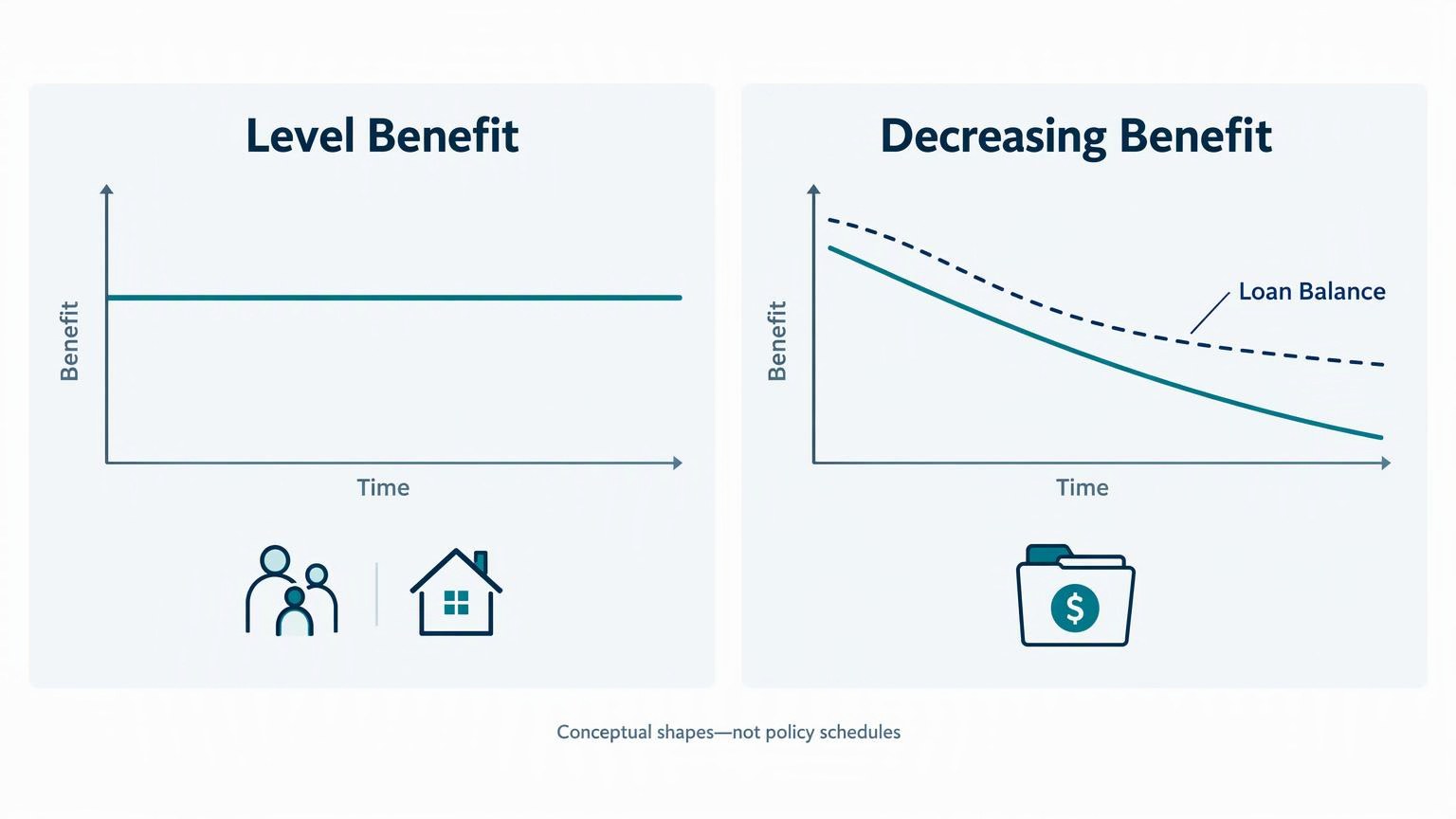
Level term fits better when your family needs a stable death benefit for more than the shrinking mortgage balance. Decreasing protection can fit when the goal is narrowly defined as covering a declining debt and other survivor needs are already funded.
A level death benefit stays constant during the selected term. A decreasing benefit falls according to the policy's schedule. That schedule is not necessarily your loan's actual balance: refinancing, additional borrowing or a changed repayment plan can create a mismatch.
Choose the coverage period as deliberately as the amount. Protection that ends before your intended mortgage or family-support horizon leaves a later gap. Compare premium schedules separately from benefit schedules, using actual proposals for the same insured person and comparable coverage periods.
Rene's California life insurance guidance provides a broader starting point if your needs extend beyond the mortgage. Permanent coverage merits a separate discussion when the obligation is lifelong, rather than a temporary loan.
Compare Protection for Your Mortgage and Family
Discuss your coverage horizon, household needs and premium budget with Rene Farias over Zoom.
How Should Mortgage Payoff and Family Income Be Balanced?
Estimate the mortgage goal and the continuing household shortfall separately, then subtract resources genuinely available to meet them. The California Department of Insurance's Life Insurance Guide recommends considering dependents, continuing income, assets and debt while balancing coverage against affordability.
Paying off a mortgage removes the loan payment, not property taxes, homeowners insurance, maintenance, food or childcare. If you budget full payoff, do not also count the same future principal-and-interest payments in your income-replacement target.
Hypothetical example: A California family wants the surviving parent to remain home while children are dependent. The survivor's income can cover ordinary living costs after mortgage payoff, but not childcare and future education needs. Premium affordability is a fixed constraint.
Debt-only decreasing protection addresses the loan but leaves those other needs unfunded. Level term sized for payoff plus the remaining shortfall better matches this family's goal, if affordable. If separate savings already covered those expenses, decreasing protection could instead be sufficient. This is a planning scenario, not a quote.

What Should You Review Before Replacing Existing Coverage?
First determine whether your existing policy already meets the mortgage goal. Keep useful coverage when it fits; consider supplemental coverage when only the amount or duration is insufficient. Replacement deserves a comparison of what you gain and what you give up, not just a lower advertised premium.
- Existing death benefit, beneficiaries, remaining term and premium schedule.
- Riders, conversion options, exclusions and any lender assignment.
- For cash-value policies, loans, surrender charges and potential tax consequences.
- Proposed coverage, underwriting requirements, effective date and replacement provisions.
Compare the new insurer's actual offer with your current contract. Do not cancel existing protection merely because you submitted an application. Confirm the new policy is issued, accepted and in force, including required payment, before ending old coverage.
Rene Farias is an independent insurance advisor based in Los Angeles who compares options across carriers through Zoom strategy sessions. He can help evaluate the insurance trade-offs. Tax consequences of surrender and legal questions about ownership or beneficiary arrangements require the appropriate tax adviser or attorney.
Work With Rene Farias
Rene Farias works with California families, professionals and business owners to compare insurance-based protection and retirement-planning strategies. He is based in Los Angeles and offers strategy sessions over Zoom.
Frequently Asked Questions
Are Life Insurance Death Benefits Taxable?
The IRS states that proceeds received by a beneficiary because of the insured's death generally are not included in gross income. Interest received is taxable, and certain transfers for value can limit the exclusion. Income-tax treatment does not resolve separate estate-tax questions; unusual ownership arrangements warrant tax advice.
Will I Need a Medical Exam?
Underwriting requirements vary by carrier, policy, coverage amount and individual circumstances. Some applicants may qualify without a medical examination; others need additional underwriting. Do not treat a no-exam description as guaranteed approval or assume a new application will preserve the terms of your existing coverage.
Should a Parent Without Paid Employment Be Insured?
Consider the cost of replacing that parent's contribution, not only wages. Childcare, household management and other responsibilities may create expenses after a death even when no paycheck disappears. Include those needs in the household assessment rather than automatically assigning all mortgage protection to the higher earner.
Is Employer Life Insurance Enough?
It may contribute meaningfully, but evaluate its amount and terms before counting it toward a long-term mortgage goal. Review what happens when employment ends or benefits change. Treat employer coverage as a resource with its own conditions, rather than assuming it will remain available throughout the loan.
Does Refinancing Mean I Must Buy a New Life Policy?
Not necessarily. Refinancing changes the debt you are planning around, so reassess the balance, repayment horizon and existing protection. A policy may still fit without replacement. If proceeds are assigned to a lender, review that arrangement separately rather than assuming it automatically updates with the refinanced loan.
Decide Whether to Keep, Supplement or Replace Your Coverage
Bring your mortgage horizon and existing policy details to a Zoom strategy session with Rene Farias. Focus the discussion on the household's remaining protection gap and which insurance approach fits your budget.