
Qualified vs Non-Qualified Retirement Accounts: Complete Guide
Qualified generally refers to an employer retirement plan meeting specific tax-law requirements, not simply money that grows tax-deferred. IRAs are a separate tax-favored category. Taxable accounts and nonqualified annuities also differ. Classify the legal account first, then its pretax, Roth or after-tax treatment before deciding how to use it.
For California families, professionals and business owners, the useful question is not which label sounds more tax-efficient. It is what you own and what rules govern it. A household can hold several account and contract types, each serving a different purpose. This guide separates those categories and shows how to organize them.
Key Considerations
- Record the legal account type separately from its pretax, Roth or after-tax components.
- After-tax funding does not make annuity earnings tax-free or remove surrender restrictions.
- Match spending needs to usable cash before treating an account balance as available income.
What Does Qualified Mean in Retirement-Plan Terminology?
In formal terminology, a qualified employer retirement plan meets requirements under section 401(a) of the Internal Revenue Code. Examples include qualified profit-sharing and defined benefit plans; a 401(k) feature can operate within a qualified plan. Qualification concerns the plan's legal structure and operation, not whether every participant's withdrawal is taxable.
These plans have rules governing matters such as participation, contributions, vesting and administration. The IRS retirement-plan definitions distinguish defined contribution accounts from defined benefit pensions and identify the plan administrator as responsible for running the plan.
Traditional and Roth IRAs are individual retirement arrangements, not section 401(a) employer plans. SEP and SIMPLE IRA arrangements also use IRAs. Everyday planning language sometimes groups them all as “qualified money,” but that shorthand is too broad for deciding eligibility, contribution rules or access. Start with the exact plan or account name on your documents.
How Do Taxable Accounts and Nonqualified Annuities Compare?
A taxable investment account holds assets outside a retirement arrangement. A nonqualified annuity is an insurance contract purchased with after-tax dollars. They share an after-tax funding source, but they do not share the same tax or access rules.
In a taxable account, taxation follows the underlying income and transactions; the account itself does not provide annuity-style tax deferral. In a nonqualified deferred annuity, earnings accumulate tax-deferred, while access depends on the contract. The California Department of Insurance's annuity guide explains after-tax funding and emphasizes surrender periods, withdrawal allowances and beneficiary provisions.
For money intended to remain accessible, compare the actual holdings and sale requirements in a taxable account with an annuity's surrender terms. For a long-term insurance-based income objective, evaluate the contract's income provisions and costs. Neither “nonqualified” nor “tax-deferred” establishes suitability by itself.
| Alternative | Suitable Purpose | Reason and Trade-Off |
|---|---|---|
| Qualified employer plan | Retirement saving through an employer or eligible business | Plan-based tax advantages; participation, contribution and distribution rules apply. |
| Traditional or Roth IRA | Individual retirement saving | Separate IRA rules; deductions, eligibility and distribution treatment depend on the type and circumstances. |
| Taxable investment account | Investing outside retirement arrangements, including access-oriented goals | No retirement-plan distribution framework; holdings, market risk and transaction taxes still matter. |
| Nonqualified deferred annuity | Long-term insurance-based accumulation or income | Tax-deferred earnings; contract costs and surrender restrictions can limit access. |
Why Are Pretax Versus Roth and Qualified Status Separate Questions?
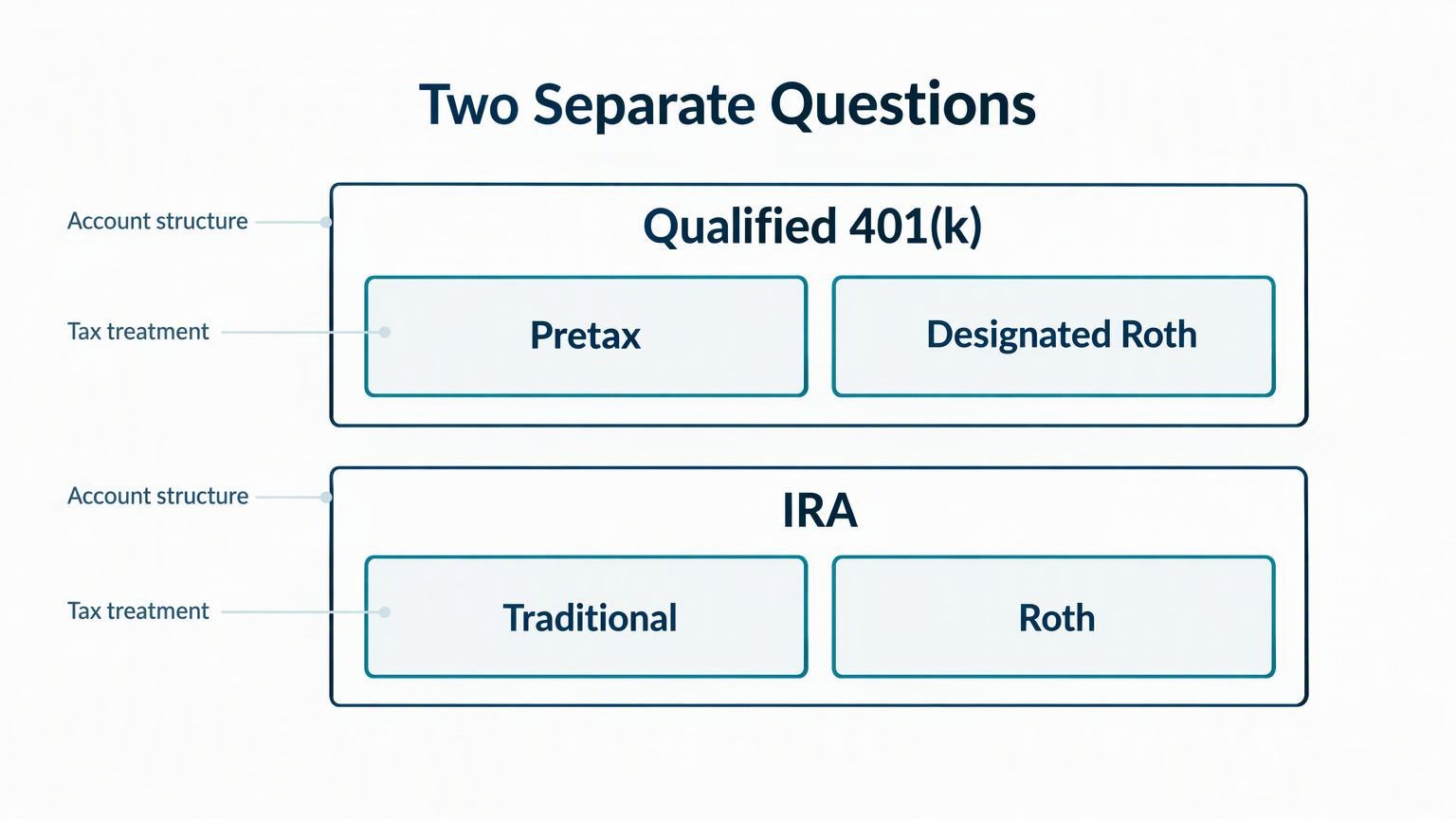
Qualified status describes a plan's structure; pretax, Roth and other after-tax amounts describe tax treatment within an account or arrangement. A qualified 401(k) can include pretax deferrals and designated Roth contributions. Choosing Roth contributions does not turn it into a nonqualified plan.
A Roth IRA belongs to the IRA category. Contributions are not deductible, and distributions are tax-free only when the applicable requirements are satisfied, as the IRS explains for Roth IRAs. “Qualified distribution” here describes a withdrawal meeting tax conditions, not classification as a qualified employer plan.
Likewise, after-tax annuity premiums do not make all proceeds tax-free. Under Internal Revenue Code section 72, nonqualified annuity withdrawals before annuitization generally draw taxable earnings first; annuitized payments generally allocate between taxable income and recovery of investment in the contract. Exceptions can apply. Tax-deferred means taxation is postponed, not eliminated.
Separate the Insurance Decision From the Account Label
Discuss with Rene Farias whether an insurance-based retirement strategy serves a defined income or protection need alongside your existing accounts.
How Do Access, Distributions and Estate Considerations Differ?
Usable cash depends on the account's distribution rules and the contract's terms, not just its balance. Employer-plan access follows plan provisions and applicable tax rules. An annuity may impose surrender charges separately from taxes. The IRS allows owners to leave money in a Roth IRA throughout their lifetime; do not assume that rule applies to every retirement arrangement.
For survivors, identify both the named beneficiary and the benefit payable. An annuity's outcome can change depending on whether death occurs before income payments begin and which payout option was selected. Income-tax treatment and estate inclusion are separate questions for your tax adviser and estate-planning attorney.
Hypothetical Example: An Upcoming Expense Versus Retirement Income
Suppose a household has an unavoidable expense before retirement and is comparing a taxable investment account with a deferred annuity whose surrender period is still active. If suitable holdings can be sold without contractual exit charges, the taxable account may better serve that expense, after considering investment risk and taxes. The annuity remains a candidate for longer-term income. The fixed spending deadline, not the shared after-tax funding label, determines the choice.

How Should You Inventory Your Actual Accounts and Contracts?
Build your inventory from statements, plan summaries and contracts, rather than marketing labels. Classify each item before evaluating a transfer, withdrawal or new policy.
- Identify the structure: employer plan, IRA, taxable account, annuity or life insurance.
- Separate tax components: record pretax amounts, Roth amounts and documented after-tax basis or premiums.
- Record access terms: distribution provisions, surrender schedules and any existing loans.
- Connect purpose and beneficiaries: mark accessible reserves, retirement income or protection, and review beneficiary designations.
If a statement says only “annuity,” use its ownership and account designation to determine whether it is held inside a retirement arrangement or separately. Send plan-operation questions to the administrator, tax-treatment questions to your tax adviser and estate documents to an attorney.
Rene Farias is an independent insurance advisor based in Los Angeles who meets California clients over Zoom. He helps compare insurance-based protection and retirement-planning strategies. His California life insurance guidance addresses protection, not a substitute classification for retirement accounts.
Work With Rene Farias
Rene Farias works with California families, professionals and business owners to compare insurance-based protection and retirement-planning strategies. He is based in Los Angeles and offers strategy sessions over Zoom.
Frequently Asked Questions
Is a TFRA or LIRP a Separate Retirement Account?
No. TFRA and LIRP describe permanent-life-insurance strategies, not distinct IRS-qualified accounts or bank accounts. Policy charges, funding and access terms matter. Read the TFRA strategy disclosures before comparing a proposal with an IRA. These labels do not establish Roth-equivalent withdrawal rights or guaranteed tax-free income.
Does an Annuity Inside a Retirement Account Add Tax Deferral?
No. An annuity inside an already tax-deferred retirement account does not supply additional tax deferral. Evaluate it for its contractual features, income options and costs instead. Keep two descriptions in your inventory: the retirement arrangement that owns it and the annuity contract held within that arrangement.
Are Permanent-Life-Insurance Loans Always Tax-Free?
No. Modified endowment contract, or MEC, rules can treat loans as distributions and apply earnings-first taxation. For a non-MEC policy, loans may receive different treatment, but surrender or lapse with debt can create taxable income. Loan interest and reduced policy values also matter. Review the specific policy with a tax adviser.
Can a Business Owner Deduct Life Insurance Premiums as Retirement Contributions?
Usually not. Ordinary life insurance premiums are not qualified-plan contributions simply because a policy supports retirement goals. Rene's guidance notes that business owners generally cannot directly deduct those premiums. Compensation or business-planning arrangements require separate tax analysis; do not infer a deduction from an insurance strategy's marketing name.
Are Insurance Guarantees Equivalent to Bank Deposit Insurance?
No. Insurance and annuity guarantees are contractual and depend on policy terms and the issuing insurer's claims-paying ability. They are not FDIC-insured bank products. Separate guaranteed benefits from nonguaranteed values when comparing a proposal, and do not treat an illustration as a promised future account balance.
Identify the Insurance Role in Your Retirement Plan
Use your account inventory to pinpoint a protection or retirement-income question for a Zoom strategy session with Rene Farias. Keep tax, legal and plan-administration decisions with the relevant professionals.