
Retirement Planning for Physicians and Dentists in California
If you are employed by a hospital or practice, start with your workplace retirement benefits and personal funding priorities. If you own a practice, compare plans using eligible staff costs and sustainable employer contributions. A defined benefit plan deserves consideration only when its funding obligations fit the business, not simply because your income is high.
Retirement planning for dentists and physicians involves separating money you can save personally from commitments your practice must support. A strong earning year can create opportunities, but it does not establish a pension budget. The useful starting point is your actual employment, ownership and compensation structure.
Key Considerations
- Map workplace and outside-income contributions together before adding another plan.
- Compare owner benefits against total staff, administration and funding costs.
- Keep retirement savings, business-continuity insurance and ownership-transfer funding distinct.
Start With Your Role: Employee or Practice Owner
A hospital employee generally chooses within an employer's benefit menu; a practice owner may select a plan but also assumes employer responsibilities. That difference changes the first planning decision.
If you are an employed physician or associate dentist, review available retirement benefits, employer contributions and your own saving capacity before considering supplemental strategies. You do not need a practice pension merely because you have a professional income.
If you own a practice, plan selection also involves the workforce, compensation definitions and business cash flow. An owner without employees may have a simpler route than an owner with eligible staff, but ownership alone does not establish solo-plan eligibility.
For example, an employed clinician with no outside business should first evaluate the workplace plan. An owner planning to hire staff should evaluate a plan that can accommodate that workforce rather than treating today's staffing arrangement as permanent. The comparison below identifies starting routes, not automatic recommendations.
Coordinate Existing Plans With Outside Clinical Income
Outside business income may support additional retirement contributions, but it does not automatically create another full personal elective-deferral allowance. The IRS one-participant 401(k) guidance explains that elective-deferral limits apply by person, not by plan, when an owner also participates in another employer's 401(k).
Start by identifying each workplace plan, contributions already made and the legal source of outside earnings. If your hospital offers a 403(b) or a 457 arrangement, have the plan administrator explain its coordination rules rather than assuming every account follows the same pattern.
Next, have your tax adviser establish compensation available for business-plan contributions. Self-employed calculations use adjusted net earnings, not gross billings. Do not treat S-corporation distributions as W-2 plan compensation.
Finally, establish employee eligibility. A solo 401(k) generally covers an owner without employees, or the owner and spouse. Hiring eligible employees changes coverage and testing responsibilities. This sequence tells you whether to investigate employer contributions, a staff-inclusive plan or personal saving alternatives.
| Situation | Suitable Starting Route | Reason | Trade-Off |
|---|---|---|---|
| Employed clinician | Workplace benefits | Use the existing employer framework | Limited control over plan design |
| Owner without eligible staff | Evaluate a solo 401(k) | Potentially simpler employee-coverage structure | Hiring can change eligibility and administration |
| Owner with staff and variable surplus | Evaluate a staff-inclusive 401(k) | Compare saving opportunities with business flexibility | Staff coverage and plan terms affect costs |
| Owner with staff and dependable surplus | Evaluate a 401(k) plus pension | Potential for greater employer-funded benefits | Actuarial funding and higher complexity |
Consider a Combined Plan When Funding Is Dependable
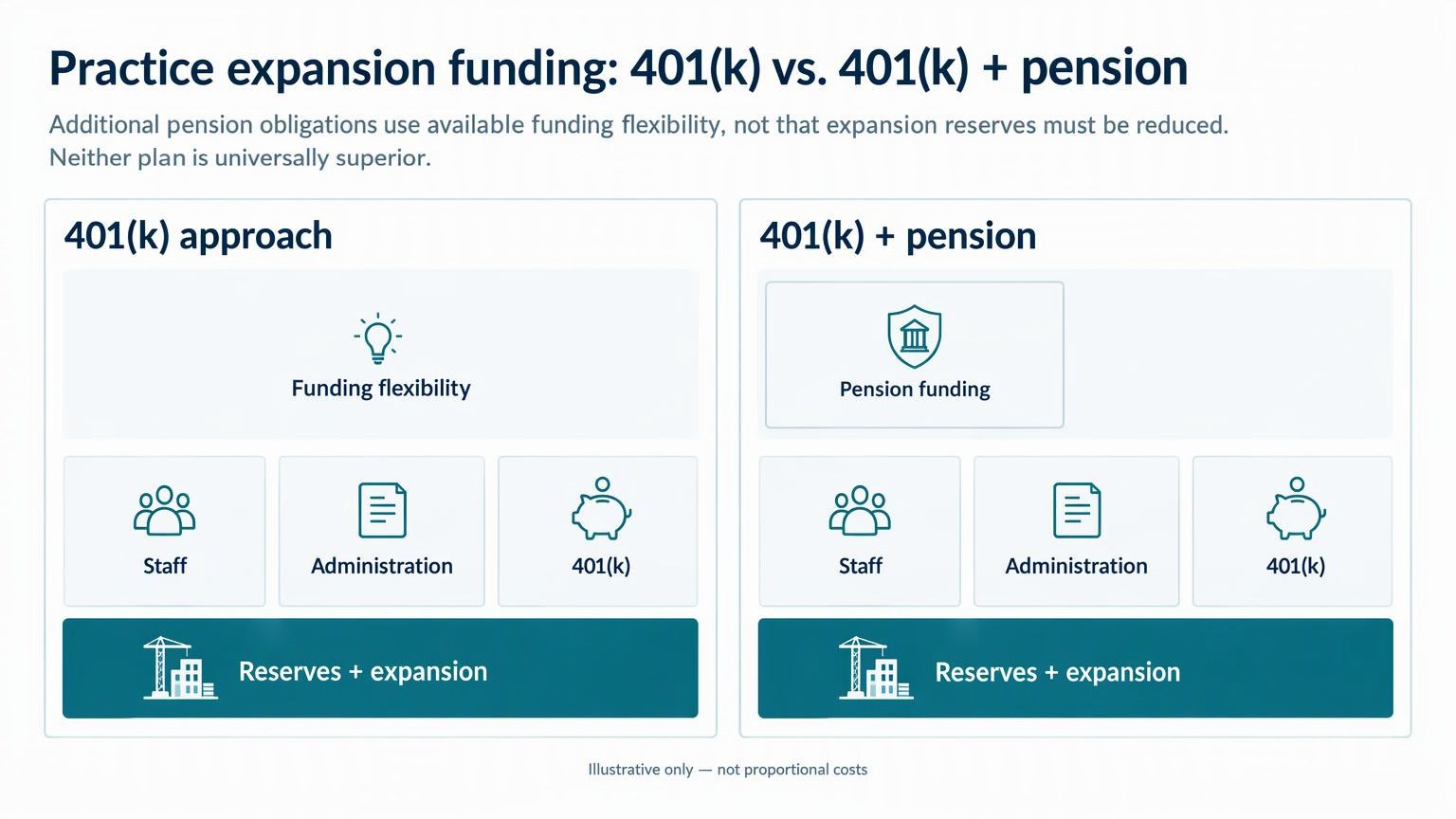
A practice can consider a 401(k) alongside a defined benefit plan when dependable surplus supports longer-term employer funding. High income is a reason to investigate, not proof that the combination fits.
A 401(k) accumulates contributions in participant accounts. A defined benefit plan promises a retirement benefit using a fixed formula, with funding determined actuarially. A cash balance plan is a form of defined benefit plan, not simply a larger 401(k).
The IRS defined benefit plan guidance confirms that an employer can maintain other retirement plans and generally may contribute more than under defined contribution arrangements. It also identifies greater cost and complexity, annual reporting and enrolled-actuary involvement.
The suitable candidate is a practice that can support the proposed funding while retaining operating reserves. A practice facing uncertain profits or major reinvestment may favor a simpler plan first. Ask the actuary to model funding across business conditions. A statutory annual-benefit limit is not your contribution allowance or a guaranteed deduction.
Fit Insurance Funding Into Your Retirement Budget
Discuss with Rene Farias how protection needs and insurance-based retirement strategies fit the cash you can commit after practice obligations.
Evaluate the Whole-Practice Cost, Not Just the Owner Benefit
Staff contributions and administration can change whether a plan is economically worthwhile. Compare total employer cash outlay with the retirement benefit allocated to you, rather than judging the proposal solely by its projected owner deduction.
Separate employee contributions from employer-funded staff benefits. Employee salary deferrals are not the same expense as practice contributions. Add plan-administration charges and, for a pension, actuarial work and funding obligations. Minimum-funding failures can trigger excise taxes; weaker profits do not automatically erase the obligation.
Hypothetical example: A dentist owns a practice with eligible staff and plans an expansion. The fixed constraint is preserving operating cash during construction. The alternatives are a 401(k) with a discretionary profit-sharing component, subject to its terms, or a 401(k) plus a defined benefit plan. If the combined proposal would consume cash needed for the expansion during a lower-profit year, the simpler route is the better starting choice. If dependable surplus remains after reserves and staff costs, the combined design merits actuarial evaluation.
To compare proposals, prepare a compact planning file:
- Workforce census and compensation information.
- Existing plan documents and contribution records.
- Operating reserves, reinvestment needs and sustainable funding capacity.
Have a plan administrator model employee coverage and allocations, an actuary model pension funding, and your tax adviser assess deductions. Compare the same workforce and business assumptions across proposals.
Coordinate Protection With the Practice's Retirement Strategy
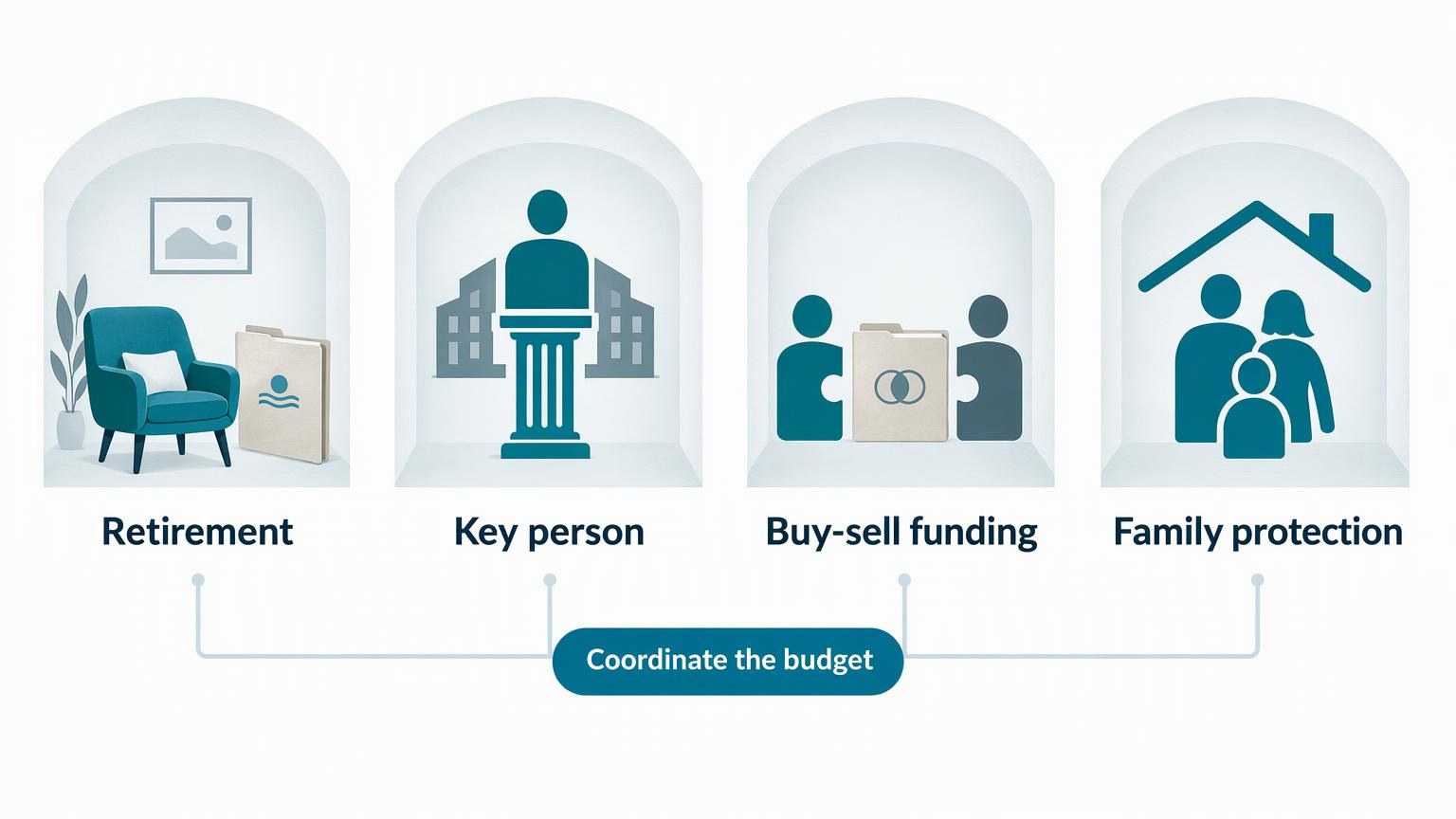
Retirement planning should coordinate with key-person and succession protection, but each addresses a different obligation. Retirement assets support future spending; insurance may provide liquidity when a death disrupts the practice or triggers an ownership transfer.
Key-person coverage addresses the business's financial exposure to losing an important person. Buy-sell funding addresses the purchase obligation established in an ownership agreement. Family life insurance addresses beneficiaries' needs. One policy should not be assumed to satisfy all three purposes.
For an owner, align the business succession insurance discussion with the agreement's ownership, valuation and funding provisions. An attorney handles the documents; a tax adviser evaluates tax treatment and employer-owned insurance requirements. Review protection premiums alongside retirement contributions so the same cash is not committed twice.
Rene Farias is an independent insurance advisor based in Los Angeles who works with California clients and multiple carriers. Strategy sessions take place over Zoom. Rene helps compare insurance-based protection and retirement-planning strategies, including life insurance options; legal drafting, tax determinations and actuarial plan funding belong with the relevant specialists.
Work With Rene Farias
Rene Farias works with California families, professionals and business owners to compare insurance-based protection and retirement-planning strategies. He is based in Los Angeles and offers strategy sessions over Zoom.
Frequently Asked Questions
Is a Cash Balance Plan a Separate Investment Account?
No. A cash balance plan is a defined benefit pension that expresses benefits through a hypothetical account formula. It should not be evaluated as though it were simply a personal brokerage account. The employer's funding responsibilities and actuarial calculations remain central to deciding whether it fits.
Does Workplace Coverage Prevent Me From Using an IRA?
Workplace coverage does not automatically prevent an IRA contribution. However, income, filing status and workplace coverage can affect whether a traditional IRA contribution is deductible. Roth IRA contribution eligibility also depends on income. Evaluate contribution eligibility and tax treatment separately rather than assuming an IRA duplicates workplace benefits.
Can I Reduce Pension Benefits After a Weak Business Year?
You cannot assume previously earned benefits can be reduced retroactively. Defined benefit plans carry funding responsibilities, and changes require specialist review. If profits weaken, consult the enrolled actuary and plan administrator before changing contributions. A temporary cash shortage is not itself permission to disregard required funding.
Is a TFRA the Same as a Qualified Retirement Plan?
No. TFRA is a marketing term for a permanent-life-insurance strategy, not a distinct IRS-qualified retirement account. It should be evaluated as insurance, with policy charges, funding requirements and access risks. Loans, withdrawals and lapse can have different consequences; tax-advantaged access is conditional, not a blanket promise.
Are Life Insurance Premiums Automatically Deductible for My Practice?
No. Life insurance premiums generally are not deductible simply because a practice pays them. The policy's purpose, ownership and any compensation arrangement require separate tax analysis. Have your tax adviser evaluate the actual structure, and do not include an assumed premium deduction when comparing insurance and retirement-plan funding.
Review the Protection Gaps Around Your Practice Exit
Use a Zoom strategy session with Rene Farias to discuss family protection, key-person exposure and insurance funding for an ownership transition. Keep your retirement-plan proposal available so the insurance discussion reflects the obligations your practice already carries.