
Retirement Planning for the Self-Employed in California: 2026 Guide
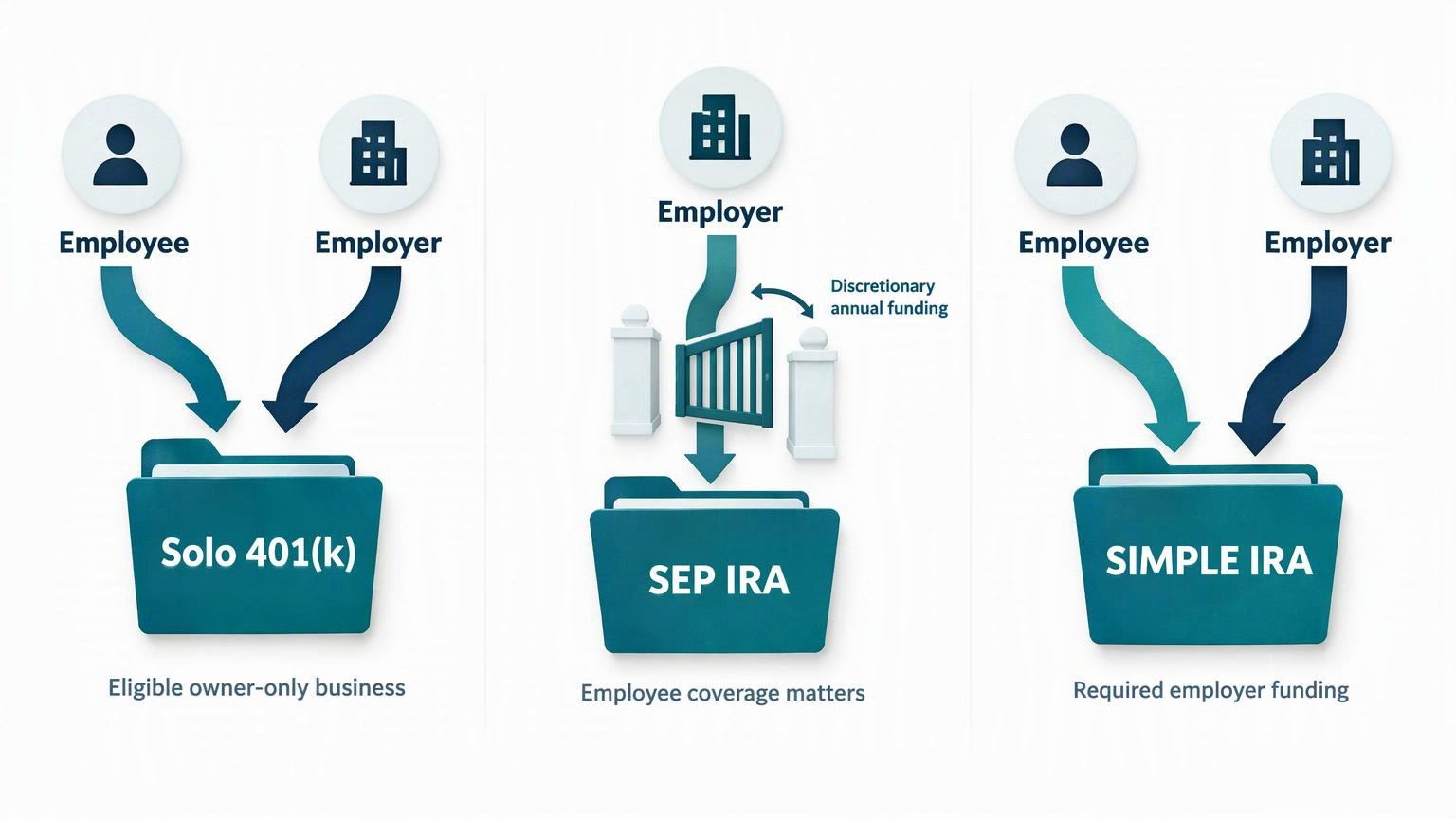
Start with eligible business earnings and employee coverage, then choose a plan you can fund through uneven income. A solo 401(k) suits eligible owner-only businesses seeking employee and employer contributions; a SEP favors discretionary employer funding; a SIMPLE supports employee saving with required employer contributions. Keep operating cash and personal protection separate.
When you work for yourself, you create the saving discipline that an employer payroll system might otherwise provide. For California freelancers, professionals and business owners, the useful goal is not simply opening an account. It is connecting your business tax structure, hiring plans and cash flow to a retirement contribution you can sustain.
Key Considerations
- Calculate contributions from eligible compensation, not gross revenue or S-corporation distributions.
- Review employee eligibility before hiring changes an owner-only retirement arrangement.
- Use a conservative saving baseline and surplus contributions rather than treating the legal maximum as a cash-flow target.
Which Business Earnings Count Toward Contributions?
Start with compensation recognized under the plan, not the amount customers paid your business. Your business's tax treatment determines the calculation.
For a sole proprietor, net business profit is the starting point. The self-employed contribution calculation adjusts net earnings for deductible self-employment tax and contributions for yourself. Because the contribution affects the calculation, applying a headline percentage directly to revenue or even unadjusted profit can produce the wrong result.
For an S-corporation owner, W-2 compensation and shareholder distributions are different. Distributions do not become retirement-plan compensation simply because you transfer them to your personal account. An LLC label alone also does not tell you which calculation applies; its tax treatment matters.
The IRS one-participant 401(k) guidance explains the special self-employed calculation. Have your tax adviser establish the earnings base before you commit to a contribution amount. A busy sales year does not necessarily mean a large allowable contribution.
Choose a Plan That Fits Your Workforce and Funding Style
Compare the solo 401(k), SEP and SIMPLE by how contributions are made and whom the business must cover. The largest advertised limit is not enough to choose.
A solo 401(k) lets an eligible owner contribute in employee and employer capacities. A SEP emphasizes employer contributions, with flexibility over annual funding. A SIMPLE IRA allows employee salary-reduction contributions and requires employer funding under its applicable formula.
For 2026, the employee 401(k) deferral limit is $24,500 before applicable catch-up contributions. The general SIMPLE employee limit is $17,000, with a higher $18,100 limit for certain applicable SIMPLE arrangements. These are employee limits, not a universal maximum for every contribution to the plan. The IRS 2026 limits announcement also describes age-based catch-ups.
Compare available plan documents and administration requirements next. Do not assume every provider offers the same features or that an IRA-based arrangement and a 401(k) have identical rules.
| Situation | Suitable Option | Reason | Trade-Off |
|---|---|---|---|
| Owner-only business seeking employee and employer contributions | Solo 401(k) | Combines two contribution capacities | Administration and eligibility changes need attention |
| Business prioritizing discretionary employer funding | SEP IRA | Annual funding can follow business results | Most SEPs require proportional funding for eligible employees |
| Business seeking an employee salary-reduction arrangement | SIMPLE IRA | Supports employee saving with employer contributions | Required employer funding and lower general employee deferral ceiling |
Hiring Employees Changes the Coverage Decision
Hiring requires an eligibility review, not necessarily an immediate plan replacement. The decisive issue is whether workers qualify for coverage under the applicable rules and plan document.
A solo 401(k) covers an owner with no employees, or the owner and spouse. When other employees become eligible, they must be included. The owner-only exemption from nondiscrimination testing no longer applies, although an appropriately designed safe harbor or other exempt arrangement may avoid that testing.
With most SEPs, funding your own benefit also means making proportional contributions for eligible employees. A SIMPLE's employer funding obligation must likewise enter your payroll budget. Employee coverage can therefore change the cost of saving for yourself.
Before hiring, give a plan administrator your workforce information, anticipated work patterns and existing plan document. Ask for an eligibility timeline and employer-funding analysis. Use that result to decide whether to retain, amend or replace the arrangement. Keep worker-classification questions with the appropriate tax or legal professional.
Include Protection in Your Hiring Review
Discuss with Rene how a growing business changes your family-protection and insurance-based planning needs, alongside your separate retirement-plan review.
Fund Variable Income With a Baseline and a Surplus Review
Set contributions from conservative cash-flow expectations, then increase them when profit and liquidity support it. The legal ceiling is a limit, not a spending instruction.
Use this funding sequence:
- Separate collected cash from unpaid invoices and update business profit estimates.
- Set aside taxes, operating needs and household reserves before identifying retirement surplus.
- Choose a modest recurring contribution or earmarked saving amount that survives a lean period.
- Review surplus periodically, then reconcile the final contribution with your tax adviser and plan deadlines.
Earmarking cash is not the same as making a plan contribution. Deferral elections, deposits and employer contributions can have different timing requirements.
Hypothetical Example: A Consultant With Late-Paying Clients
Suppose an owner-only consultant has profitable contracts but unpredictable collections. The fixed constraint is preserving cash for taxes and essential expenses until clients pay.
A SEP suits the consultant if the priority is discretionary employer funding after profit becomes clearer. A solo 401(k) merits comparison if employee deferrals are important and the consultant can manage its administration and election timing.
If flexibility and simplicity are the priorities, the SEP is the better fit in this scenario. The consultant earmarks surplus as payments arrive and finalizes funding from adjusted eligible earnings. Neither choice justifies contributing against an unpaid invoice or calculating the deposit from gross contract value.

Protect the Saving Plan Without Sacrificing Liquidity
Keep emergency liquidity outside the long-term saving commitment, and evaluate insurance against a specific financial risk. Retirement assets, accessible cash and insurance perform different jobs.
If others depend on your income, life insurance can address financial needs following your death. Extended care expenses require a separate discussion; long-term care insurance is not interchangeable with life insurance or every living-benefit rider.
Permanent life insurance may support a supplemental retirement strategy when protection needs and sustainable funding justify it. It is not a substitute for emergency cash. Policy charges, surrender provisions and funding requirements matter, and nonguaranteed values are not promised. Do not redirect needed operating reserves into a policy because an illustration shows future cash value.
Rene Farias is an independent insurance advisor based in Los Angeles who works with California clients through Zoom strategy sessions. His role is comparing insurance-based protection and retirement-planning options. Your tax adviser handles tax calculations, a plan professional handles administration, and an attorney handles legal implementation.
Work With Rene Farias
Rene Farias works with California families, professionals and business owners to compare insurance-based protection and retirement-planning strategies. He is based in Los Angeles and offers strategy sessions over Zoom.
Frequently Asked Questions
Can I Save Through My Business While Also Using a Day-Job 401(k)?
Yes, but employee elective-deferral limits apply by person, not separately to each 401(k). Coordinate contributions across jobs before making business-plan deferrals. Employer contributions require a separate calculation and may involve additional aggregation rules. Give your tax adviser and plan administrator information about both arrangements rather than treating them independently.
Can I Open a SEP After the Business Year Ends?
A SEP can generally be established for a year as late as the business income-tax return due date, including extensions. That flexibility does not establish the deadline for another plan type. Arrange the written agreement and participant accounts, then coordinate the contribution and deduction with your tax adviser.
Can My Spouse Participate in an Owner-Only 401(k)?
A one-participant 401(k) can cover the business owner and spouse when the spouse works for the business. Participation and contributions still depend on eligible compensation and plan rules. Marriage alone does not create a contribution allowance. Coordinate employment records, compensation and enrollment with your payroll and plan professionals.
When Does a Defined Benefit Plan Deserve Consideration?
It may merit evaluation when the business can support ongoing funding obligations rather than only occasional surplus deposits. An actuary calculates contributions using the promised benefit and other factors. An annual benefit limit is not a contribution limit or guaranteed deduction. Compare funding commitments and employee costs before proceeding.
Is a TFRA Another Self-Employed Retirement Account?
No. TFRA is a marketing term for a permanent-life-insurance strategy, not a distinct IRS-qualified retirement account or bank account. It should be evaluated separately from your employer plan. Policy charges, funding, access provisions and possible tax consequences matter; the name does not establish unlimited tax-free deposits or guaranteed income.
Decide What Your Retirement Savings Need to Protect
Use a Zoom strategy session with Rene Farias to discuss whether family protection, extended care planning or supplemental insurance-based retirement planning belongs alongside your saving system. Keep your eligible-earnings calculation and plan implementation with the appropriate tax and plan professionals.