
Retirement Planning in California: 2026 Guide for Business Owners
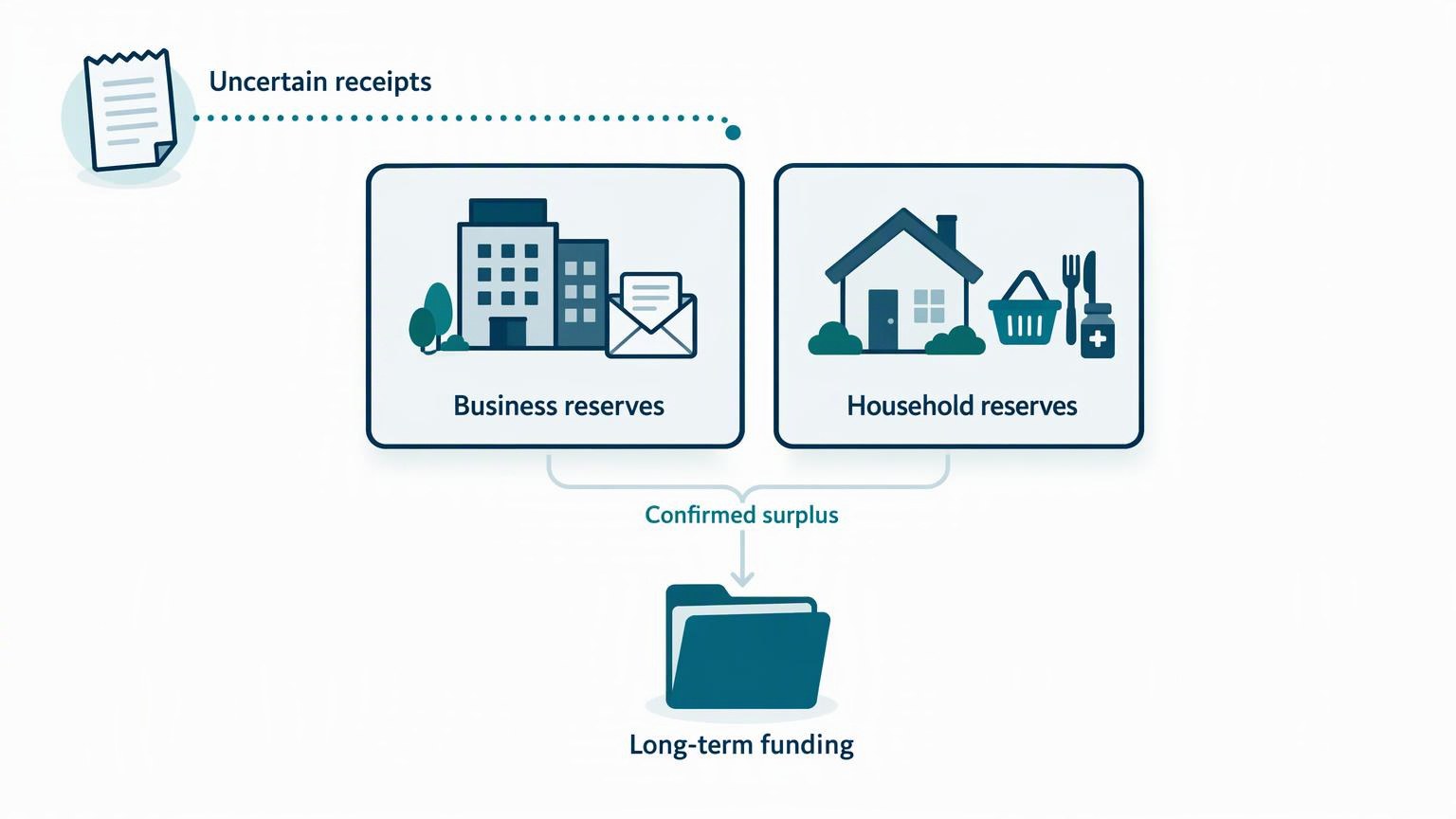
For California business owners, retirement planning should begin with cash flow, not a product. Separate business and household reserves, then match sustainable surplus to retirement saving, protection and future income needs. Favor flexible funding when earnings vary; consider longer-term commitments only when reserves, employee obligations and succession plans can support them.
Your business may be your largest asset, but its value is not the same as spendable retirement income. This framework connects what you own today with when you will need income, what could interrupt it and which professionals should implement each part.
Key Considerations
- Do not count business operating cash as a household retirement reserve.
- Plan contribution limits are ceilings, not funding recommendations.
- A succession agreement needs a funding strategy, not just signatures.
What Should You Inventory Before Choosing Products?
Inventory your assets, obligations and income timeline before comparing accounts or policies. The objective is to identify a funding gap, not simply total your net worth.
- Business finances: entity structure, owner compensation, recurring expenses, debt, employees and seasonal cash demands.
- Household finances: spending, debt, accessible savings, retirement accounts and existing insurance.
- Income timing: when you expect to reduce work, when other income starts and which expenses continue.
- Ownership transition: intended successor, valuation assumptions, buy-sell documents and expected sale-payment structure.
Separate reliable resources from assumptions. A hoped-for business sale should not carry the same weight as assets already available outside the business. Likewise, record whether retirement balances are pretax, Roth or taxable rather than treating every balance as equivalent spending power.
Your first output should be a timeline showing household expenses and expected income before, during and after the transition. That reveals whether you need more saving, a temporary income bridge or protection against a specific interruption.
How Should Business and Household Liquidity Be Separated?
Give business operating reserves and household reserves separate jobs. Business cash supports payroll, taxes, debt service and operations; household cash supports personal expenses and unexpected needs. The same dollars cannot safely serve both commitments.
Estimate reserve needs from actual expenses and plausible disruptions, rather than applying an arbitrary universal target. Only the surplus remaining after those needs is a candidate for long-term funding. A retirement transition may require an additional accessible reserve if owner compensation ends before replacement income begins.
A Hypothetical Owner Facing Delayed Receivables
Suppose an owner plans to reduce work while a major customer's payments remain uncertain. The fixed constraint is keeping payroll and household bills funded without relying on those receivables.
The alternatives are committing the apparent surplus to long-term retirement funding now or retaining the transition cash and funding from confirmed surplus later. Retaining liquidity is the stronger choice here because the payment delay affects both business operations and personal income. Once receipts arrive and reserves remain intact, the owner can reassess contributions with the plan professional. If earnings instead were dependable and reserves already adequate, earlier funding could be reasonable.
| Approach | Suitable Need | Reason and Trade-Off |
|---|---|---|
| Accessible reserves | Uncertain receipts or a retirement income gap | Keep spending capacity available; do not count this money as long-term funding. |
| Employer retirement plan | Sustainable retirement accumulation | Provides a structured savings framework; eligibility and administration matter. |
| Life insurance | Family or succession funding after death | Addresses a protection gap; premiums and policy terms must fit. |
| Annuity | Contractual retirement income | Can support ongoing spending; liquidity and survivor choices involve trade-offs. |
What Do Qualified Plans Add to the Strategy?
Qualified employer plans provide a structured way to save for retirement, with tax treatment and funding rules tied to plan design. They are not substitutes for operating reserves. IRAs are a separate category; Roth describes tax treatment, not a universal plan type.
For 2026, the IRS sets the basic 401(k) employee-deferral limit at $24,500. Catch-up eligibility and employer contributions require separate analysis. That employee limit does not establish your total permissible contribution or what your business can afford.
A defined-contribution approach can suit an owner seeking retirement accumulation with an appropriate funding structure. A defined-benefit or cash balance pension merits consideration when the business can support ongoing funding and administration. The IRS explains that defined-benefit funding requires an enrolled actuary and carries greater complexity and cost.
Have the plan professional evaluate employee coverage, eligible compensation, deadlines and administration before selecting a design. Do not calculate contributions from gross revenue or treat S-corporation distributions as W-2 plan compensation. A pension's annual-benefit limit is not a contribution limit or an automatic deduction.
Where Can Insurance or Annuities Serve a Distinct Purpose?
Use insurance to address a defined risk, and consider annuities for a defined income requirement. Neither should be selected merely because retirement saving feels incomplete.
Life insurance can provide death-benefit funding for family obligations or an ownership transition. The discussion in Business Succession Insurance belongs alongside the attorney's buy-sell work: a policy does not establish the ownership-transfer rules. Long-Term Care Insurance addresses extended-care expenses, a different risk from death-benefit protection.
An annuity may fit when you want contractual income for a portion of retirement spending. Compare the income start date, survivor provisions, access restrictions and charges, not just an advertised rate. California's Department of Insurance annuity guide emphasizes early-withdrawal charges and identifying the insurer that holds the contract, even when a bank sells it.
Permanent life insurance can combine protection with cash value, but charges, funding requirements and access consequences matter. Insurance guarantees depend on contract terms and the issuing insurer's claims-paying ability; these are not FDIC-insured bank products. Rene Farias helps California clients compare insurance-based protection and retirement-planning options.
Identify the Risk Your Retirement Savings Do Not Cover
Discuss family protection, succession funding or contractual income needs with Rene Farias before comparing insurance options.
What Needs Annual Review, and Who Handles It?
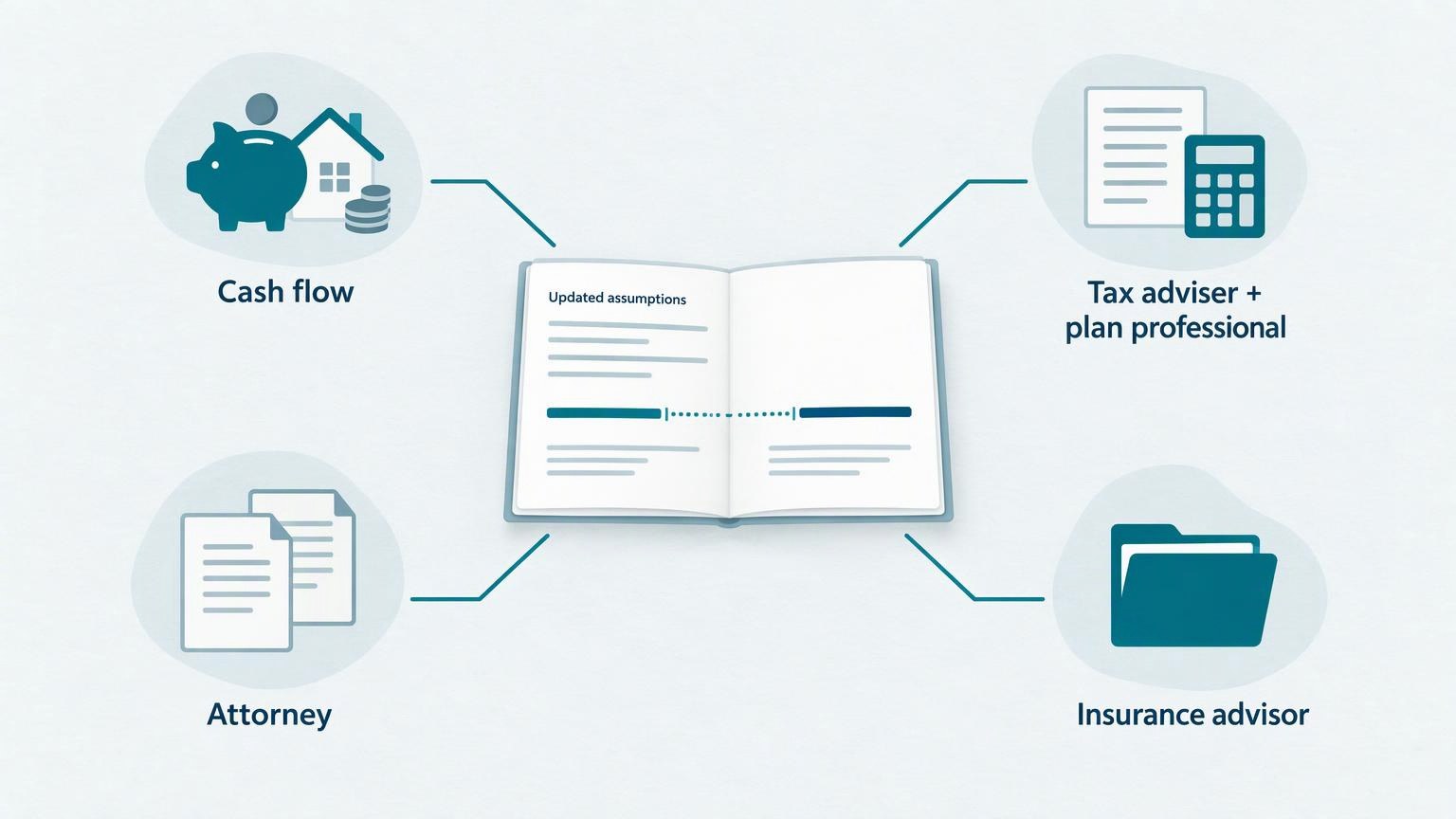
Review cash flow, plan compliance, ownership arrangements and insurance sustainability together each year. Start with changed assumptions, then assign the resulting work to the professional responsible for it.
- Update the financial picture. Reconcile compensation, reserves, household spending and expected retirement dates.
- Recalculate plan funding. Your tax adviser and plan professional assess contribution calculations, employee obligations, filings and applicable federal and California tax treatment.
- Revisit succession documents. Your attorney reviews ownership-transfer provisions, valuation arrangements, estate documents and beneficiary coordination.
- Review insurance performance. Examine coverage needs, premiums, current policy values, loans and whether future funding remains sustainable.
During the transition, map when salary stops, sale proceeds arrive and retirement income begins. A delayed sale payment may change the liquidity requirement even if the agreed business value stays unchanged.
Rene is an independent insurance advisor based in Los Angeles, with strategy sessions over Zoom. His role is insurance-based guidance, not legal drafting, tax advice or plan administration. Bring those specialists into decisions that change contributions, ownership or tax treatment.
Work With Rene Farias
Rene Farias works with California families, professionals and business owners to compare insurance-based protection and retirement-planning strategies. He is based in Los Angeles and offers strategy sessions over Zoom.
Frequently Asked Questions
Is a TFRA a Special California Retirement Account?
No. TFRA is a marketing term for a permanent-life-insurance strategy, not a separate IRS-qualified account or bank account. Cash-value access depends on policy design and tax rules. Review the TFRA Strategy Disclosures before treating it as a supplemental income approach or comparing it with an IRA.
Does Indexed Universal Life Mean I Own an Index Investment?
No. Indexed universal life is permanent life insurance, not direct ownership of a stock index. Index-linked crediting follows policy terms. A crediting floor does not stop charges, loan costs or surrender charges from reducing cash value, and caps, participation rates, spreads and nonguaranteed illustrations may change.
Should Business Sale Proceeds Be My Entire Retirement Plan?
Relying entirely on a sale leaves retirement dependent on the buyer, transaction timing and payment terms. Model a delayed sale or installment payments alongside your preferred outcome. Assets outside the business can reduce that dependence, while your tax and legal advisers evaluate the proposed transaction before you commit.
Should I Pay Down Debt Before Increasing Retirement Funding?
Compare the debt's cost and required payments with your reserve needs and the consequences of committing cash elsewhere. Paying down debt may reduce future household spending, but using every available dollar can leave you short of liquidity. The useful decision is which obligation most threatens your transition, not simply which balance is largest.
Does an Annuity Inside a Tax-Deferred Retirement Account Add Tax Deferral?
No. The account already supplies tax deferral, so that alone is not a reason to buy an annuity inside it. Evaluate the contract for its income provisions, guarantees, costs and access restrictions. Its value must come from those features, with guarantees subject to the insurer's claims-paying ability.
Choose the Protection Gap to Address Next
For your strategy session with Rene Farias, prepare a short list of the family, succession or retirement-income needs your current arrangements leave unresolved. Use that discussion to determine whether an insurance-based approach has a distinct job in your plan.