
Solo 401(k) vs SEP IRA vs Defined Benefit Plan: Which Fits Your Business?
For an owner-only business, start with a solo 401(k) if employee deferrals matter, or a SEP IRA if simpler employer-funded saving is your priority. Consider a defined benefit plan when dependable profits support ongoing actuarial funding. Eligible employees, compensation and administration can change which option fits best.
The solo 401(k) vs SEP IRA vs defined benefit plan decision is not simply a contest between contribution ceilings. For California business owners, the useful comparison is what each structure requires from the business today and as it grows. Start with eligibility, then compare funding capacity, obligations and operating costs.
Key Considerations
- An owner-only 401(k) must change its employee-coverage approach when eligible employees join.
- The same contribution ceiling does not mean a SEP and solo 401(k) permit the same contribution at your income.
- A pension promises a formula-based benefit, so funding is not merely an annual savings preference.
Who Can Use a Solo 401(k)?
A solo 401(k) covers a business owner with no employees, or the owner and a working spouse. It is a traditional 401(k) operating in an owner-only setting, not a separate plan type with unlimited special privileges.
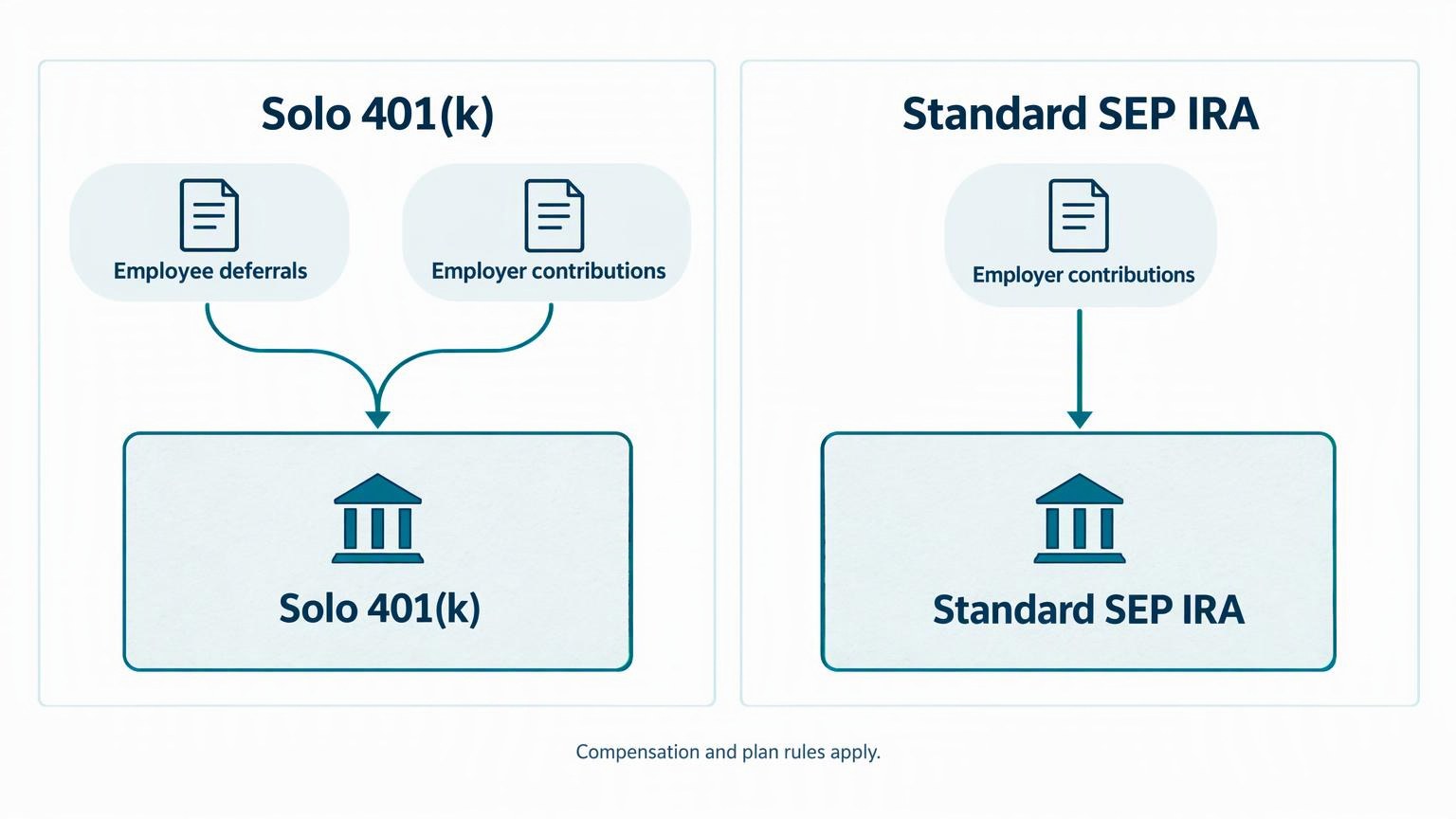
You contribute in two capacities: as an employee making elective deferrals and as an employer making permitted employer contributions. That combination is its central contribution advantage over a standard SEP.
Business structure matters less than the workforce and the compensation calculation. A sole proprietor uses an adjusted self-employment earnings calculation, not gross receipts. Before opening an owner-only plan, have a plan professional review anyone working for the business and the applicable eligibility rules. Calling the account a “solo” plan does not authorize excluding an otherwise eligible employee.
How Do SEP Contributions Differ From Employee Deferrals?
A standard SEP is funded through employer contributions to participants' SEP IRAs. It does not provide the separate employee salary-deferral feature available in a solo 401(k). Regular personal IRA contributions, where permitted, are a different contribution category.
Under IRS Notice 2025-67, the 2026 elective-deferral limit is $24,500. The defined-contribution annual-additions dollar ceiling is $72,000, subject to compensation and applicable plan rules; eligible catch-up contributions are separate. For a solo 401(k), employer contributions and regular employee deferrals share that overall ceiling. A SEP's employer contributions also face compensation-based restrictions, so the dollar ceiling is not automatically available.
Consequently, a solo 401(k) can allow more saving at a given income because elective deferrals add a contribution route that a standard SEP lacks. A SEP may still be preferable when simpler administration matters more than maximizing capacity. A SEP is an IRA-based employer arrangement; a solo 401(k) is an employer-qualified plan. Similar tax advantages do not make them interchangeable.
| Structure | Suitable Situation | Contribution Approach | Main Trade-Off |
|---|---|---|---|
| Solo 401(k) | Owner-only business seeking employee-deferral capacity | Employee deferrals plus permitted employer contributions | Plan administration and coverage changes when eligible employees join |
| SEP IRA | Business prioritizing simpler employer-funded saving | Compensation-based employer contributions | No standard salary deferrals; most SEPs require proportional employee allocations |
| Defined benefit plan | Business with sustainable profits and a substantial retirement-funding goal | Actuarial funding of a formula-based benefit | Continuing funding obligations and greater administrative complexity |
How Does a Pension Change Annual Funding Obligations?
A defined benefit pension replaces an account-contribution target with a pre-established retirement benefit formula. An enrolled actuary determines the funding needed to support that formula. Your preferred savings amount alone does not determine the required contribution.
The IRS defined benefit plan guidance explains that these plans can generally support larger contributions and deductions than defined-contribution plans, but are more complex and costly to maintain. They require annual reporting and actuarial involvement; failure to satisfy minimum funding requirements can trigger an excise tax.
This changes the cash-flow test. The question is not only whether profits are high this year, but whether the business can sustain the commitment through weaker years. Accrued benefits cannot simply be reduced retroactively. Also, a pension's annual-benefit limit measures a retirement benefit, not an annual contribution or guaranteed tax deduction. Compare an actuarial funding proposal with your business budget, not that benefit limit with a 401(k) deposit.
Keep Protection Needs in Your Funding Budget
Discuss with Rene how insurance-based protection priorities fit alongside the retirement contributions your business can sustain.

What Happens When You Hire Eligible Employees?
Hiring an employee who satisfies eligibility requirements changes the plan's coverage obligations. A solo 401(k) cannot remain owner-only by ignoring that employee. The owner-only nondiscrimination-testing advantage disappears, although a properly designed safe harbor or another exemption may change testing requirements.
Most SEPs require the same contribution percentage for eligible participants. Funding your own SEP can therefore require funding employees' SEP IRAs as well. Simpler paperwork does not necessarily mean a smaller employer contribution budget.
A defined benefit plan likewise needs employee-coverage and benefit-design analysis. The relevant cost is the whole plan, not merely the owner's desired benefit. Give your plan administrator advance notice of hiring plans so eligibility dates, payroll processes and funding projections can be updated. Hiring does not automatically make a pension best or a SEP unsuitable; it changes the comparison.
Which Structure Fits a Sole Proprietor or Established Practice?
An owner-only sole proprietor should compare solo 401(k) contribution capacity against SEP simplicity. An established practice with dependable profits and a larger retirement-funding goal should also investigate a defined benefit plan, including employee costs. Neither business label determines the answer by itself.
A Hypothetical Decision With Variable Profits
Suppose an independent consultant has no employees, uneven profits and a fixed requirement to preserve operating reserves. The consultant wants meaningful retirement saving but cannot commit to sustained pension funding.
A defined benefit plan is not the first fit: its funding obligation conflicts with that constraint. A solo 401(k) is the stronger starting point if combining deferrals and employer contributions provides useful capacity. A SEP is a reasonable alternative if the consultant accepts potentially lower contribution capacity in exchange for simpler administration. By contrast, a practice with predictable surplus cash can justify paying for an actuarial pension study, provided the analysis includes its employees.
Turn the Shortlist Into an Implementation Plan
First, have your CPA establish usable plan compensation and an affordable funding budget. Next, give a plan administrator your workforce information and request comparable designs showing owner contributions, employee costs and administration. If a pension remains viable, obtain an enrolled actuary's funding analysis before adopting it.
Rene Farias is an independent insurance advisor based in Los Angeles who meets California clients over Zoom. His planning for business owners and retirement planning for physicians and dentists address the broader protection context. Rene can discuss insurance-based protection and retirement-planning strategies alongside your plan decision. Tax calculations, legal documents, actuarial work and plan administration belong with the relevant professionals.
Work With Rene Farias
Rene Farias works with California families, professionals and business owners to compare insurance-based protection and retirement-planning strategies. He is based in Los Angeles and offers strategy sessions over Zoom.
Frequently Asked Questions
Can I Have a Solo 401(k) Alongside My Employer's 401(k)?
Potentially, if your separate business qualifies. However, elective-deferral limits apply to you as a person, not separately to each plan. Tell your tax adviser and plan administrator about contributions through your other employer so they can coordinate limits rather than treating the solo plan as a fresh deferral allowance.
When Must SEP Contributions Be Deposited?
For the intended tax-year deduction, SEP contributions generally must be deposited by the business's federal income-tax return filing deadline, including a valid extension. Filing and contribution dates are distinct. Have your tax adviser coordinate the deposit with the deduction year rather than assuming the account's deposit-year reporting determines deductibility.
Can a Business Maintain a Defined Benefit Plan and a 401(k)?
Yes, a defined benefit plan can coexist with another retirement plan. That does not mean you can simply add advertised maximums together. Have the plan administrator, actuary and tax adviser evaluate the combined design, employee coverage, contribution limitations and deduction treatment before deciding how much the business will fund.
Can I Calculate My Contribution From Business Revenue?
No. Gross revenue is not the contribution base. Self-employed owners need an adjusted earned-income calculation that accounts for relevant deductions, including the retirement contribution itself. Entity structure also matters. Ask your CPA to establish eligible compensation before relying on an account provider's maximum-contribution display or an informal revenue-based estimate.
Does an Owner-Only Plan Eliminate Annual Reporting?
Not necessarily. A solo 401(k) can have annual reporting requirements depending on its circumstances and assets. A defined benefit plan requires annual reporting and actuarial involvement. Include filing responsibilities in your administrator comparison, and identify who prepares and submits required forms rather than assuming the account custodian handles every obligation.
Connect Your Plan Shortlist With Your Protection Priorities
Bring your retirement-plan shortlist to a Zoom strategy session with Rene Farias to discuss the insurance-based protection needs that should sit alongside it. Keep plan design and tax implementation with your plan professionals.