
Survivorship Life Insurance: Complete Guide for California Couples
Survivorship life insurance generally pays after both insured people die, subject to the policy's terms. Consider it for a need that arises after the second death, such as legacy funding or estate liquidity. If your spouse needs money when you die, evaluate first-death protection instead, or alongside survivorship coverage.
For California couples, choosing life insurance starts with identifying who will need money and when. A surviving spouse's household budget is a different obligation from support for a dependent after both parents are gone. Your existing coverage, accessible assets and estate documents help determine whether another policy fills a genuine gap.
Key Considerations
- Separate policies can address different coverage amounts and durations for each spouse.
- Estate liquidity needs can exist even when federal estate tax is not owed.
- Policy ownership affects control and potential estate inclusion, not just who receives the benefit.
When Does Survivorship Life Insurance Pay?
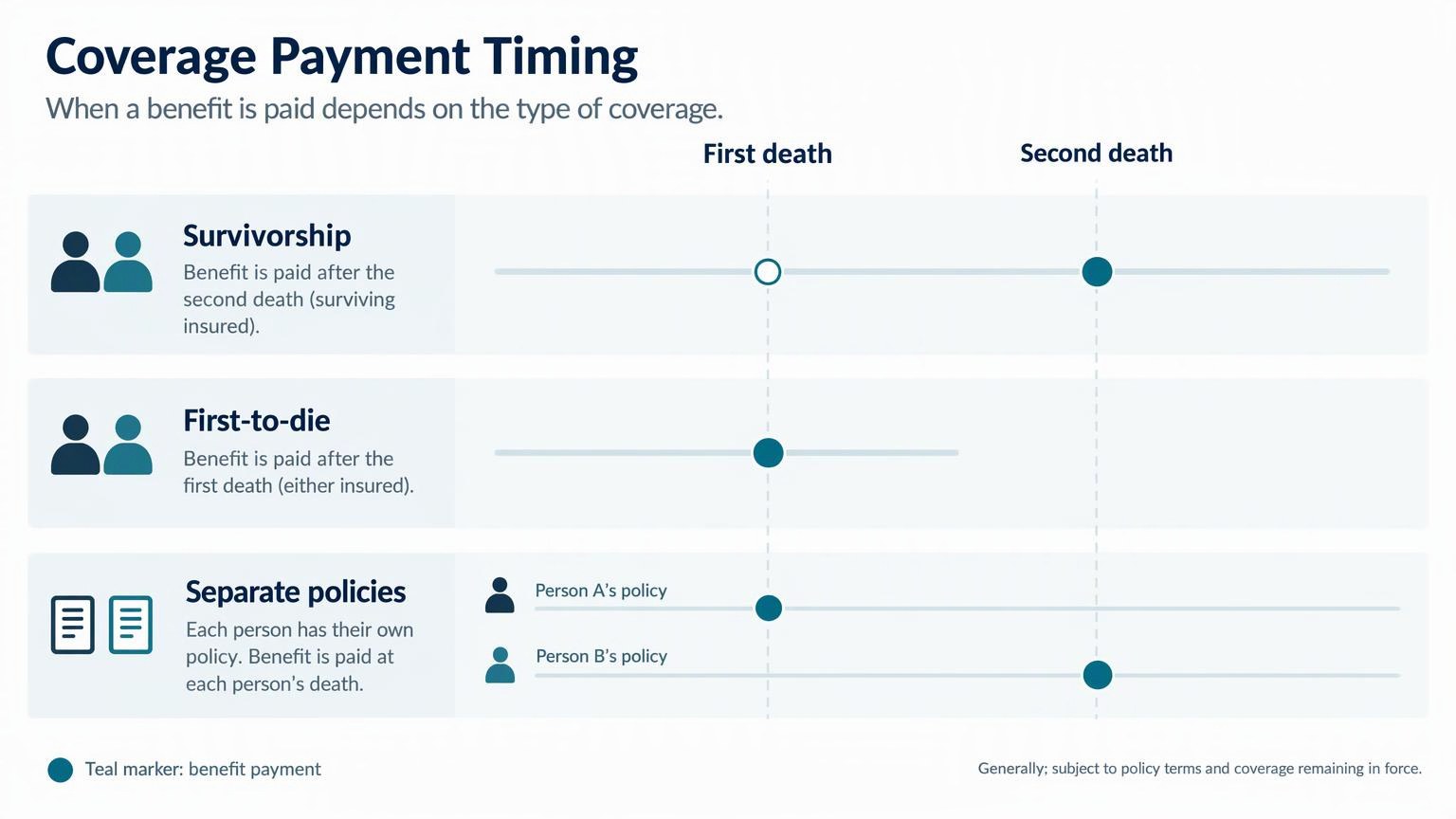
Survivorship life insurance, also called second-to-die coverage, insures two people and generally pays its death benefit after the second insured dies. The base death benefit does not pay simply because the first insured has died.
That sequence matters throughout the policy's life. After the first death, the surviving household or other funding source must still support whatever payments the contract requires. Do not assume premiums automatically stop when one insured dies.
The benefit also depends on coverage remaining in force and the claim satisfying the contract. A stated death benefit is not a substitute for understanding funding requirements, exclusions and any reductions affecting the amount payable. The California Department of Insurance's Life Insurance Guide recommends comparing contracts carefully and reading the policy. For survivorship coverage, start with the payment trigger and the obligations that continue after the first death.
How Does It Compare With First-to-Die and Separate Policies?
Choose first-to-die joint coverage when the shared need begins at the first death; consider separate policies when each spouse needs independently tailored protection. Survivorship fits a benefit intended for recipients after both deaths.
First-to-die joint coverage generally pays when the first insured dies, rather than providing a second death benefit later. Two separate policies insure each person independently, allowing different amounts or coverage periods. The survivor's own policy can remain in force under its terms.
Do not compare these options on premium alone: their payment schedules purchase different protection. Compare equivalent needs, benefit amounts, coverage duration and funding requirements before assessing affordability. Joint coverage is not automatically cheaper or better. The broader California life insurance planning question is whether the proposed contract covers the financial loss your family actually faces.
| Structure | Suitable Need | Payment Timing | Trade-Off |
|---|---|---|---|
| Survivorship policy | Funding intended after both deaths | Generally after the second death | Does not supply the base death benefit to the first survivor |
| First-to-die joint policy | A shared obligation triggered by either death | Generally at the first death | Does not provide a separate second-death benefit |
| Two separate policies | Different protection needs for each spouse | Each pays upon its insured's death, subject to terms | Requires separate coverage and funding decisions |
Compare Coverage Around Your Family's Timeline
Discuss with Rene which obligations require a first-death payout and which belong in a second-death funding plan.
What Can It Fund for an Estate or Continuing Dependent?
Survivorship proceeds can provide money after both deaths for estate-related obligations or a dependent's continuing support. The useful question is whether available liquid assets already meet those needs without selling property or business interests.
Liquidity and tax liability are different. A family may want readily available funds even when no federal estate tax is due. The IRS estate-tax guidance lists real estate, insurance, trusts and business interests among potentially includible assets. Its 2026 filing threshold is $15,000,000, applied to the gross estate plus adjusted taxable gifts and the specific gift tax exemption. A filing threshold is not a calculation of tax owed.
For a continuing dependent, the death benefit supplies capital, not a care or distribution plan. Decide who will manage the money and how it will support the person. If benefits eligibility is involved, have an attorney review the beneficiary arrangement before naming the dependent directly.
Why Does It Not Replace First-Death Income Protection?
It does not replace first-death income protection because the surviving spouse may face an immediate cash shortfall while the survivorship death benefit remains unpaid. Income replacement must respond when income is lost.
Hypothetical example: A couple depends on both earnings for household expenses and wants to fund support for an adult dependent after both parents die. Their fixed premium budget cannot support every proposed policy.
Survivorship alone addresses the later goal but leaves the immediate household gap. First-to-die coverage addresses the first loss, but its payout does not create a separate later benefit. Individual policies can protect each spouse's income contribution, with any later dependent-support gap evaluated separately.
The reasoned priority is first-death protection if accessible savings cannot sustain the survivor. If existing individual coverage already fills that gap, the couple can evaluate survivorship for the remaining later need. Layering may fit both goals, but only if the combined funding commitment is sustainable.
How Should Ownership, Beneficiaries and Trusts Be Reviewed?
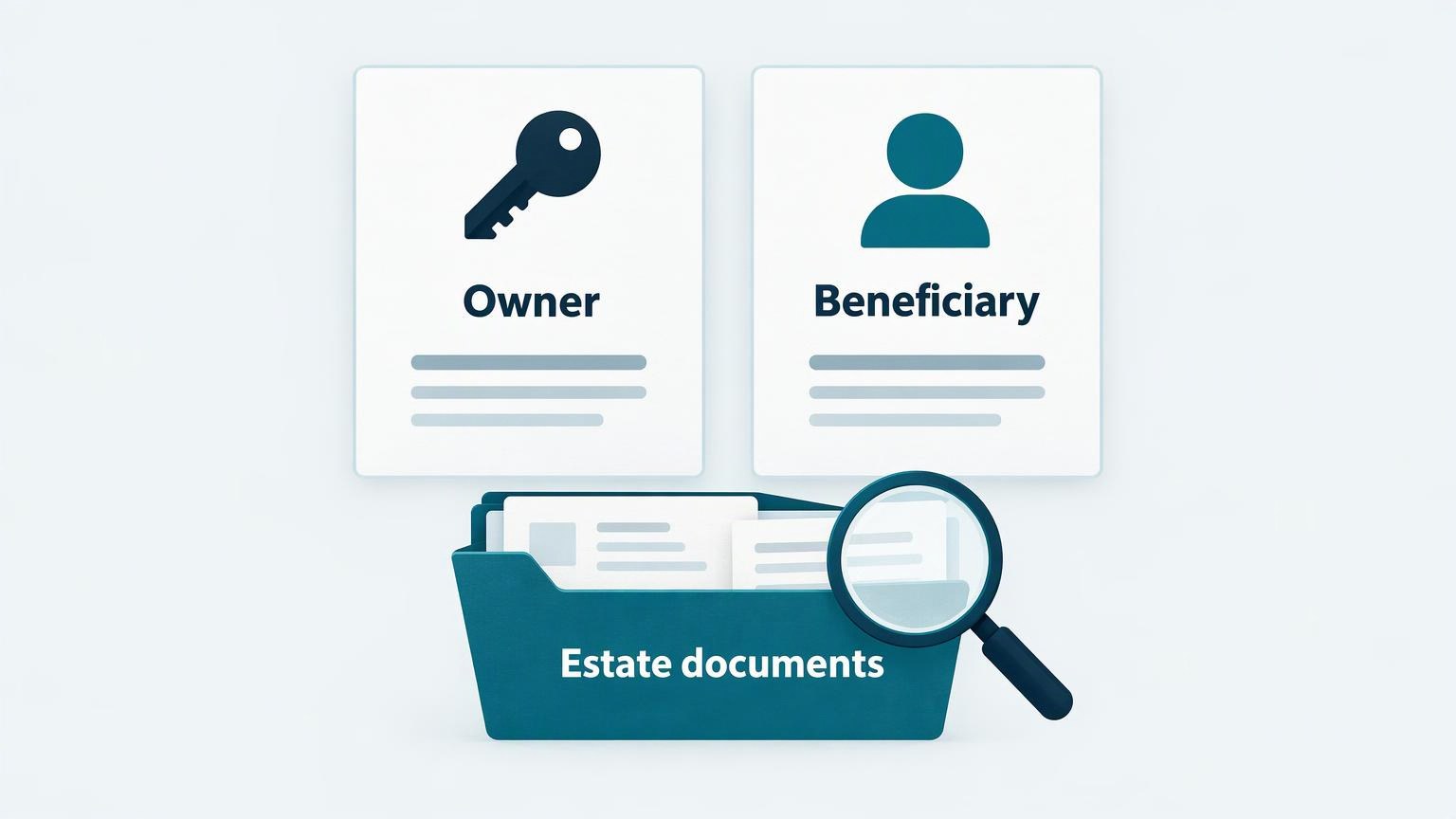
Review who controls the policy, who receives the proceeds and how that arrangement fits your estate documents before finalizing coverage. The owner and beneficiary perform different roles: ownership carries policy rights, while the beneficiary is designated to receive the benefit.
Income-tax treatment does not settle estate-tax treatment. The IRS explains that death proceeds are generally excluded from a beneficiary's gross income, with exceptions, while interest received is taxable. Separately, Section 2042 addresses estate inclusion for proceeds payable to the executor and certain proceeds where the decedent retained incidents of ownership.
An irrevocable life insurance trust, or ILIT, is a legal planning arrangement, not a policy feature that automatically eliminates estate tax. An attorney and tax adviser should determine its suitability, funding and administration.
Use this sequence:
- Map first-death and second-death obligations against existing coverage and liquid assets.
- Compare contract funding requirements and guaranteed versus nonguaranteed elements.
- Have your attorney and tax adviser review ownership, beneficiaries, trust provisions and any proposed transfer.
- Finalize the insurance arrangement, then revisit it when family circumstances or estate documents change.
Rene Farias is an independent insurance advisor based in Los Angeles, offering California clients strategy sessions over Zoom. Rene's role is comparing insurance-based protection options; legal drafting, tax advice and trust administration belong with the appropriate professionals.
Work With Rene Farias
Rene Farias works with California families, professionals and business owners to compare insurance-based protection and retirement-planning strategies. He is based in Los Angeles and offers strategy sessions over Zoom.
Frequently Asked Questions
Is Survivorship Coverage Always Less Expensive?
No universal price advantage should be assumed. A meaningful comparison requires the actual proposed premiums, benefit amounts, funding periods and contract terms. A lower payment is not a better value if the policy pays at the wrong event or cannot remain in force under your funding plan.
Does One Spouse's Poor Health Guarantee Acceptance?
No. Do not treat joint coverage as guaranteed acceptance or simplified underwriting. The insurer evaluates the application under its requirements, and the actual offer determines whether coverage is available and on what terms. Compare the issued offer with your needs rather than relying on assumptions about either spouse's health.
Can the Policy Be Split After a Divorce?
Do not assume a survivorship contract can be divided into individual policies. Any separation or conversion option depends on the specific contract. Before changing ownership or beneficiaries, review the policy with the insurer and your attorney so the insurance arrangement and any divorce agreement are addressed together.
Does Survivorship Insurance Include Living Benefits?
The second-death benefit alone does not establish access to money during life. Any accelerated-benefit provision or rider must be evaluated separately for its trigger, limits and effect on the remaining benefit. Do not treat a living-benefit rider as interchangeable with comprehensive long-term care insurance.
Should We Cancel Existing Coverage While Applying?
Do not cancel existing protection merely because you have submitted a new application. Acceptance, final terms and the date new coverage takes effect may still be unresolved. Review replacement consequences first, including whether you would lose first-death protection that the proposed survivorship policy does not replace.
Review the Funding Gap Before Choosing a Policy
For your strategy session with Rene Farias, prepare a summary of existing coverage, the obligations you want funded and any ownership questions for your attorney. Focus the discussion on the remaining gap, not simply on adding another policy.