
Term Life Insurance vs Permanent Life Insurance: Which Should You Choose?
Choose term life insurance when your main need ends on a reasonably predictable timeline and you want coverage that fits your budget. Consider permanent insurance when a death benefit is needed throughout life and you can sustain its funding. For term vs whole life insurance, duration and affordability should lead the decision.
A mortgage, dependent support and a lasting legacy do not necessarily require the same insurance. Separating those obligations helps you avoid buying too little protection today or committing to premiums you cannot maintain. For California households, the useful starting point is the financial gap a death would leave, followed by how long that gap will exist.
Key Considerations
- Match the coverage end date to the obligation, not simply the shortest available term.
- Conversion and renewal protect different options, each within contractual limits.
- Compare permanent-policy guarantees and required funding separately from projected values.
How Does Term Life Insurance Work?
Term life insurance provides a death benefit for a specified period while coverage remains in force. If the insured dies during that period, the insurer pays the policy's death benefit to the beneficiary under its terms. Ordinary term insurance has no cash value, and surviving the selected term does not produce a maturity benefit.
The California Department of Insurance's Life Insurance Guide explains that term can provide more coverage for a limited budget when protection is needed for a specified period. That makes it relevant to income replacement during child-raising years or debt repayment.
Do not assume every term policy has an identical premium schedule. Compare the guaranteed premiums and coverage period in the actual contract. The California life insurance decision starts with protection needs, not a promised savings outcome.
When Do 20- or 30-Year Terms Match Your Need?
A 20-year term fits an obligation expected to end within that horizon; a 30-year term fits one that continues longer. The relevant date is when survivors could manage without the insured's financial contribution, not necessarily when a child reaches adulthood.
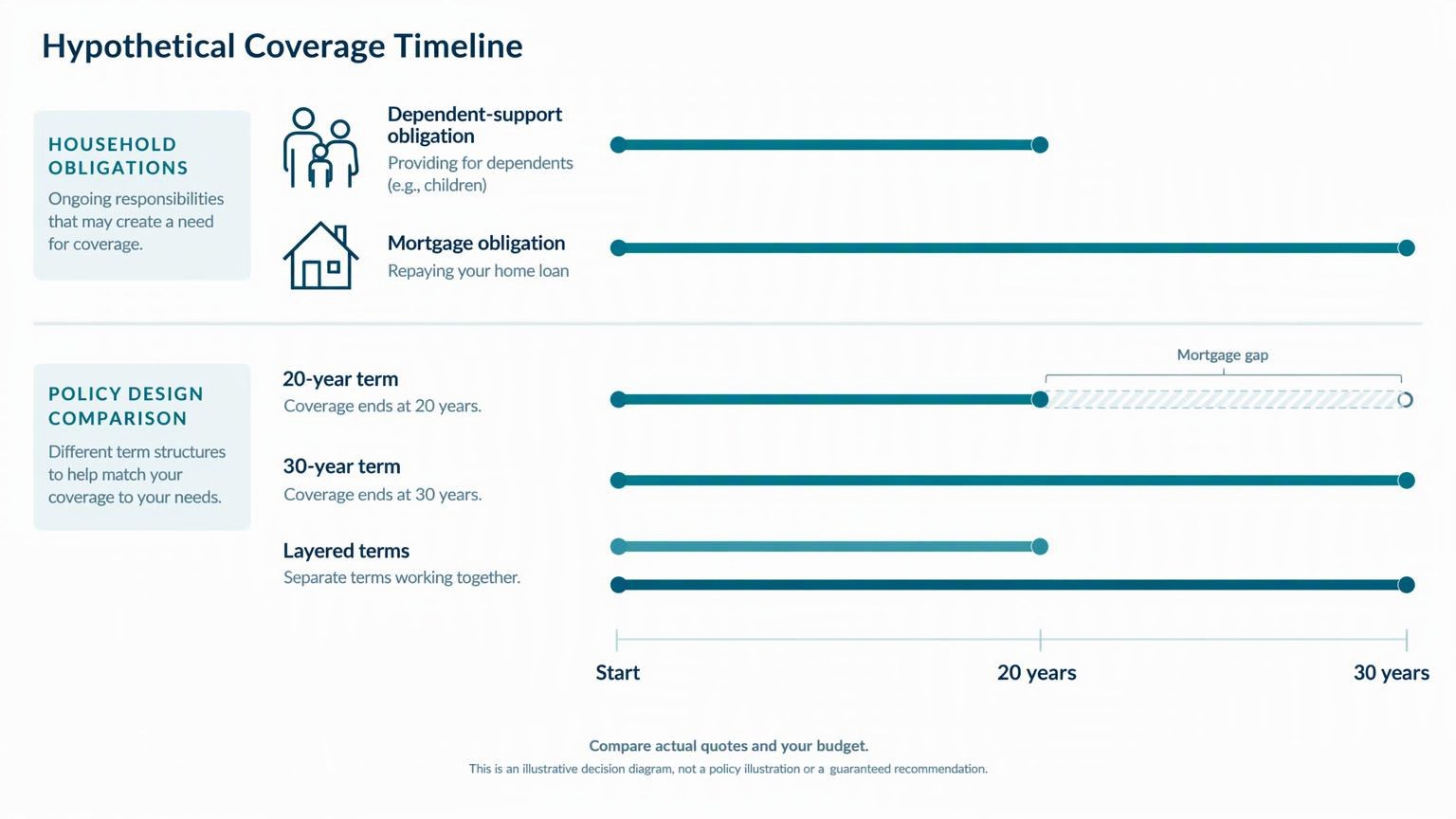
Consider a hypothetical household that expects dependent support to end within 20 years but has a mortgage lasting 30 years. Its fixed constraint is an affordable premium budget, and it does not have enough assets to clear the mortgage after an early death.
A single 20-year policy would leave the later mortgage obligation unprotected. A 30-year policy would span both needs, but might retain more coverage than necessary after dependent support ends. Another alternative is layered terms: shorter coverage for dependent support and longer coverage for the remaining debt.
The reasoned choice is to compare the longer single policy against the layered design using actual quotes. Reject a shorter-only solution unless other resources can cover the later gap.
| Situation | Suitable Approach | Reason | Trade-Off |
|---|---|---|---|
| Dependent support or debt with a defined end date | Term insurance | Aligns protection with a temporary obligation | Later needs may outlast the selected term |
| A lasting death-benefit need and sustainable funding | Permanent insurance | Designed to maintain lifetime protection under policy terms | Long-term funding and early-exit costs require attention |
| Large temporary need plus a smaller lasting need | Term and permanent coverage together | Assigns each policy a different financial job | Combined premiums and contracts need ongoing review |
Compare Coverage Against Your Family's Timeline
Discuss your dependent-support and mortgage horizons with Rene Farias over Zoom, including whether one term or layered coverage fits your budget.
What Do Conversion and Renewal Provisions Change?
Renewal extends term protection; conversion changes eligible term coverage into a cash-value policy. Neither means you can keep your original premium indefinitely.
The California Department of Insurance notes that renewal without a physical examination may be available for the period specified in the policy. Some term coverage can also be converted without a physical examination up to a specified age, generally at higher premiums.
Conversion matters when a temporary need becomes lasting or future health could make a new application more difficult. Renewal matters when you need additional temporary protection. A right to continue coverage is useful only if the resulting premium is affordable.
- Identify the conversion deadline and eligible permanent policies.
- Read renewal ages, premium schedules and examination provisions.
- Distinguish contractual rights from a new application requiring underwriting.
Review these provisions before purchase, rather than discovering their limits near expiration.
When Is Permanent Coverage the Better Fit?
Permanent coverage is relevant when the death-benefit need has no expected end date and its funding fits your long-term budget. Examples include final obligations or an intended legacy. Term remains suitable for temporary needs; a combination can separate temporary income protection from a smaller lasting obligation.
Whole life is one type of permanent insurance, designed for lifetime protection with level premiums under its payment schedule. Universal life separates premiums, death benefit and cash value, with charges deducted from policy funds. Flexible payments do not remove the need to keep the policy adequately funded.
Compare guaranteed values with nonguaranteed projections. Early surrender can involve substantial penalties. Guarantees depend on contractual terms and the issuing insurer's claims-paying ability; dividends and projected values are not promises.
Turn the Choice Into a Proposal Comparison
First separate temporary and lasting obligations, subtract available resources, and set a premium budget sustainable during leaner periods. Then compare proposals against those same needs. For permanent coverage, examine the funding needed to maintain protection, not just illustrated cash value.
Rene Farias is an independent insurance advisor who works with multiple carriers and helps California clients compare coverage needs, goals and budgets. For business succession insurance, he can discuss insurance funding; an attorney handles buy-sell documents, and a tax adviser addresses tax implementation.

Work With Rene Farias
Rene Farias works with California families, professionals and business owners to compare insurance-based protection and retirement-planning strategies. He is based in Los Angeles and offers strategy sessions over Zoom.
Frequently Asked Questions
How Much Life Insurance Should I Buy?
Estimate the obligations survivors would face, including ongoing support, debts and final expenses. Subtract assets and continuing income available for those needs. The goal is to cover the remaining gap without premiums undermining your budget. Coverage amount and coverage duration are separate decisions, so calculate both.
Should I Count Life Insurance Provided by My Employer?
Count it as an existing resource, but first read the benefits information for its amount and the conditions under which coverage ends or continues. Do not assume it will remain available after a job change. Build your household plan around coverage you understand, including any individual policy you own.
Are Life Insurance Death Benefits Taxable?
The IRS states that death benefits received by beneficiaries are generally excluded from gross income, but interest received is taxable. Transfers for valuable consideration can limit the exclusion, subject to exceptions. Income-tax treatment and estate inclusion are different questions; have your tax adviser assess ownership and your circumstances.
Can I Borrow Against a Term Policy?
Ordinary term insurance has no cash value to borrow against. Cash-value policies may permit loans under their contractual terms, with interest charged. Outstanding loans reduce proceeds at death or surrender. A loan is not a free withdrawal, and lapse or surrender can create tax consequences requiring tax-adviser review.
Does a Business Owner Always Need Permanent Insurance?
No. A business obligation with a defined duration may fit term insurance, while a continuing funding need may justify considering permanent coverage. Start with the obligation the death benefit must fund. Ownership, beneficiaries and agreement terms also matter, so coordinate the insurance decision with the business's attorney and tax adviser.
Choose the Coverage Horizon Before the Policy
Bring your temporary and lasting obligations, existing coverage and sustainable premium budget to a Zoom strategy session with Rene Farias. Use those priorities to discuss term and permanent options before committing to a policy's funding schedule.